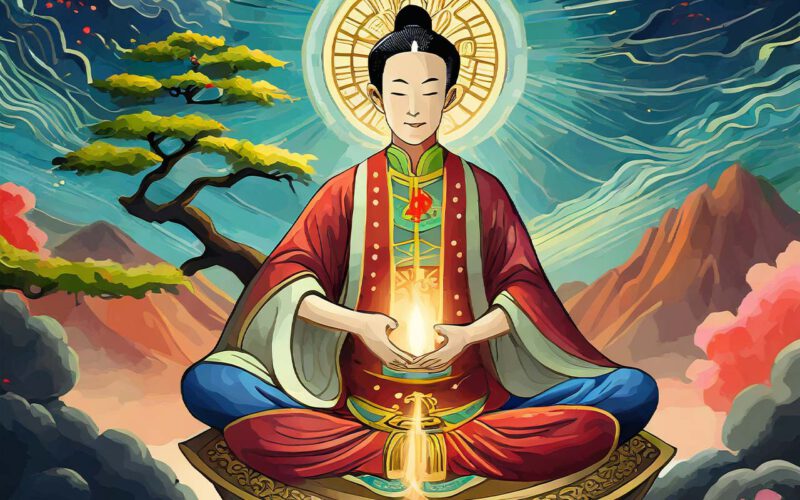
In Western medicine, the heart is a pump — a remarkable one, but a pump nonetheless. In Traditional Chinese Medicine, the heart is something far more. It is the Emperor. The ruler of all organs, the residence of consciousness, and the keeper of our deepest spirit. When the Heart Meridian is balanced, we experience joy, clarity, and genuine connection with others. When it is disturbed, the effects ripple outward into every area of life — sleep, memory, relationships, and the sense of meaning itself.
The Heart in Traditional Chinese Medicine
In the five-element framework of TCM, the Heart belongs to the Fire element — the most Yang of all elements, associated with warmth, light, transformation, and the peak of activity. Summer is its season. Red is its color. Joy is its emotion. And its organ partner — its Yang counterpart — is the Small Intestine.
But what makes the Heart uniquely important in TCM is its relationship with Shen — often translated as “spirit” or “consciousness,” but encompassing far more than either word alone suggests. Shen is the luminous, aware quality of mind. It includes perception, cognition, memory, emotional intelligence, and the capacity for meaningful relationship. In TCM, Shen does not live in the brain. It lives in the Heart.
This is why TCM refers to the Heart as the Emperor (Junzhu). Just as the emperor of an ancient kingdom sets the tone for the entire realm — when the ruler is wise and peaceful, everything flourishes; when the ruler is disturbed, chaos spreads — the Heart sets the tone for the entire body-mind system. A healthy Heart means a clear, calm mind, restful sleep, and genuine warmth in relationships. A disturbed Heart means anxiety, insomnia, scattered thinking, and emotional turbulence.
The Pathway of the Heart Meridian
The Heart Meridian (Shou Shao Yin — Hand Lesser Yin) begins in the heart itself, then divides into three branches:
- One branch descends through the diaphragm to connect with the small intestine
- One branch ascends along the throat to the eye
- The main external branch travels from the heart to the armpit, then down the inner arm, through the wrist, and ends at the inner tip of the little finger at Heart 9 (Shaochong)
The meridian has 9 points in total — fewer than most other meridians, which reflects the Heart’s special status. In classical TCM, the Heart was considered so precious that it was protected by the Pericardium (Heart Protector), which takes the brunt of many pathogenic influences before they can reach the Heart itself. This is why many conditions that might seem “Heart” related in TCM are actually treated through the Pericardium Meridian instead.
The Heart Meridian is most active between 11am and 1pm according to the TCM organ clock — the midday period when Yang energy reaches its peak. This is traditionally a time for a brief rest after the noon meal, allowing the Heart’s energy to consolidate rather than being depleted by continued activity.
What the Heart Meridian Governs
The Heart Meridian’s sphere of influence is broad and deep:
- Shen (spirit and consciousness) — mental clarity, perception, memory, and the quality of awareness
- Blood circulation — the Heart governs Blood and the blood vessels, influencing cardiovascular health in both Eastern and Western frameworks
- Sleep — Shen “rests” in the Heart during sleep; when Heart energy is disturbed, Shen becomes restless and sleep suffers
- Speech — the Heart opens to the tongue in TCM; heart imbalances often manifest in speech patterns — rapid talking, stuttering, or on the other extreme, becoming unusually quiet and withdrawn
- Joy and connection — the emotion of the Heart is joy (Xi), particularly the joy that arises from genuine human connection and meaning
- Complexion — a healthy Heart brings a natural radiance and warmth to the face; Heart deficiency often shows as a pale or grayish complexion
- Sweating — in TCM, sweat is considered the “fluid of the Heart”; excessive or spontaneous sweating (especially at night) can indicate Heart imbalance

Joy, Connection, and the Emotional Dimension
The emotion associated with the Heart is joy — but TCM understands this with important nuance. A moderate, genuine experience of joy nourishes the Heart. But excessive excitement, overstimulation, or the frantic pursuit of pleasure actually depletes it. This is the paradox many people in modern life encounter: endlessly seeking stimulation — scrolling, entertainment, novelty — while feeling increasingly empty and disconnected.
In TCM terms, this frantic activity scatters the Shen. The Heart becomes like a candle in the wind — flickering, unable to settle, consuming itself in the attempt to stay bright.
Conversely, what truly nourishes the Heart is genuine connection — with other people, with meaningful work, with nature, and with one’s own inner life. The joy that arises from deep conversation, creative expression, or a moment of genuine beauty does not exhaust the Heart. It fills it.
TCM also acknowledges the darker side of the Heart’s emotional spectrum. When Shen is disturbed, there may be anxiety, fearfulness, agitation, and a sense of meaninglessness. In severe cases, Heart disharmony in TCM correlates with what Western medicine calls depression, anxiety disorders, and certain kinds of confusion or cognitive difficulty.
Signs of Heart Meridian Imbalance
Because the Heart governs both the cardiovascular system and the mind, imbalance shows up on both levels:
Heart Yin or Blood Deficiency (most common pattern)
- Difficulty falling asleep or staying asleep; vivid, disturbing dreams
- Anxiety or restlessness without clear cause
- Poor memory, difficulty concentrating
- Palpitations (awareness of the heartbeat, especially at rest)
- Night sweats
- Pale face, dry lips
- Feeling emotionally disconnected or “hollow”
Heart Fire (excess pattern)
- Intense restlessness or agitation
- Feeling hot, especially in the chest or face
- Mouth ulcers (the Heart opens to the tongue and mouth)
- Rapid speech or racing thoughts
- Insomnia with an overactive mind
- Excessive thirst
Heart Chi Stagnation
- Sensation of constriction or heaviness in the chest
- Palpitations with a sense of anxiety
- Emotional flatness or difficulty feeling joy
- A sense of being stuck or going through the motions
Key Acupuncture Points on the Heart Meridian
Heart 3 — Shaohai (Lesser Sea)
Located at the inner elbow crease when the elbow is bent. This is the Water point on the Fire meridian — it has a cooling, calming effect on Heart Fire. Used for anxiety, agitation, palpitations, and emotional turbulence. It also treats pain along the inner arm and elbow.
Heart 7 — Shenmen (Spirit Gate)
Located at the inner wrist crease, on the little-finger side. This is the single most important and most used point on the entire Heart Meridian — the source point that directly nourishes Heart chi and Blood, and calms the Shen. Its name alone — “Spirit Gate” — tells you its function. Used for insomnia, anxiety, palpitations, poor memory, excessive dreaming, emotional instability, and any condition involving a disturbed or scattered mind. This is the first point to consider for anything heart-related in TCM acupressure.
Heart 8 — Shaofu (Lesser Palace)
Located on the palm, where the little finger rests when you make a fist. This is the Fire point of the Fire meridian — strongly moving and clearing. Used for Heart Fire patterns: agitation, palpitations, burning sensations in the chest, mouth ulcers, and heat-type insomnia.
Heart 9 — Shaochong (Lesser Surge)
Located at the inner corner of the little fingernail. This is the well point — the beginning of the channel’s surface pathway. Used in emergencies for sudden loss of consciousness and for strongly clearing Heart Fire. It can be firmly pressed (not needled) as a first-aid acupressure point for shock, fainting, or acute anxiety.

Daily Practices to Nourish the Heart Meridian
1. Acupressure on Heart 7 (Shenmen) — The Single Most Useful Thing
Find the inner wrist crease on the little-finger side — there is usually a small depression just beside the tendon. Using the thumb of your opposite hand, apply gentle but firm circular pressure for 2–3 minutes. Breathe slowly. Practice on both wrists. This point can be pressed any time you feel anxious, scattered, or unable to sleep. Many people notice a palpable sense of calming within a minute or two of sustained pressure.
For insomnia specifically, press HT7 on both wrists for 3–5 minutes while lying in bed before sleep, keeping the breath slow and the mind gently focused on the sensation of pressure.
2. Protect the Shen: Create Genuine Stillness
In TCM, one of the most important things you can do for Heart health is to create regular periods of genuine quiet. Not passive screen consumption (which stimulates and scatters Shen), but actual stillness — sitting without input, walking in nature without headphones, meditation, or simply resting with eyes closed for 10 minutes after the midday meal.
The classical TCM recommendation is to rest briefly around noon — when the Heart Meridian is at its peak activity. Even 10–15 minutes of lying down or quiet sitting can make a meaningful difference to energy levels in the afternoon and to sleep quality at night.
3. Heart-Opening Breathing Practice
This simple practice combines breathwork with intention to directly nourish the Heart:
- Sit comfortably with your spine upright. Place one hand gently on your chest, over your heart.
- Close your eyes and take three slow, deep breaths, letting the belly expand on the inhale and fall on the exhale.
- On each inhale, imagine warm, golden-red light filling the chest — bright and steady, like a lamp.
- On each exhale, let any tension, anxiety, or scattered energy dissolve and release.
- After a few minutes, simply rest your attention on the area of the heart. Notice the warmth. Notice the beating. Be present with it without trying to change anything.
- Practice for 5–10 minutes.
This practice is particularly effective in the morning to set a grounded, clear tone for the day, or in the evening to begin transitioning the mind toward rest.
4. Heart-Nourishing Foods
TCM associates the Heart with the color red and bitter flavors. Foods that nourish Heart Blood and calm the Shen include:
- Red foods: red dates (jujube), red beans, goji berries, red beets, tomatoes
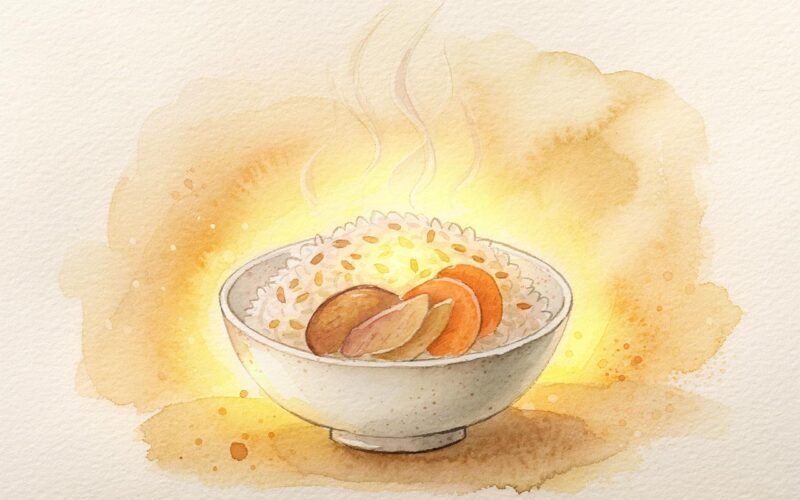
- Longan fruit — used extensively in Chinese herbal medicine specifically to nourish Heart Blood and calm the mind; eaten as a food or taken as a tonic tea
- Lily bulb (Baihe) — a classic TCM herb-food for calming the Shen and clearing Heart Heat; gentle enough to cook into congee or soups
- Wheat and oats — nourishing to Heart yin and calming to the nervous system
- Lotus seeds — used to calm the mind, support sleep, and strengthen the heart
- Dark leafy greens — nourish Blood broadly, supporting the Heart’s governing function
- Bitter greens in moderation — dandelion, chicory — gently clear Heart Fire without depleting
Avoid: excessive spicy food, alcohol, coffee in large amounts, and very stimulating foods — all of which can stoke Heart Fire and disturb the Shen.
5. Cultivate Genuine Joy — Not Stimulation
This is perhaps the most important and most overlooked practice for Heart health. Ask yourself honestly: what in my life produces a deep, settled sense of joy — not excitement, not distraction, but genuine warmth and meaning?
For some people it is time with close friends. For others, creative work, music, being in nature, or spiritual practice. The Heart needs regular nourishment from these sources — not as a luxury, but as a fundamental requirement for health.
In TCM, a life structured around endless stimulation and productivity, with little room for genuine connection and joy, is not just psychologically unfulfilling — it is a medical condition. The Heart will eventually express its depletion through insomnia, anxiety, palpitations, or disconnection. The remedy is not a supplement. It is a life that includes more of what truly matters.
6. Protect the Heart Flame Before Sleep
The hour before sleep is critically important for Heart health in TCM. In the modern world, this hour is often filled with screens, stimulating content, and the lingering stress of the day — all of which scatter the Shen and make it harder for it to settle into restful sleep.
Simple changes with real effect:
- Dim the lights after 9pm — bright light is Yang and activating
- No screens in the final 30–60 minutes before sleep
- Drink a cup of calming tea — chamomile, passionflower, or the traditional Chinese combination of longan and red dates simmered in water
- Brief journaling to empty the mind of unfinished thoughts
- The Heart 7 acupressure practice described above
The Heart Meridian and the Modern World
Of all the meridians, the Heart Meridian may be the one most challenged by contemporary life. Chronic stress, information overload, social fragmentation, and the replacement of genuine connection with digital simulation all create conditions that disturb the Shen and deplete Heart energy.
The symptoms are widespread and recognizable: difficulty sleeping, persistent low-level anxiety, a sense of going through the motions without genuine joy, difficulty being fully present in conversation, and a pervasive feeling of disconnection — from others, from one’s own body, from meaning.
TCM does not see these as purely psychological problems or chemical imbalances. It sees them as expressions of a disturbed or depleted Heart — and it addresses them through restoring what the Heart needs: adequate rest, genuine nourishment, meaningful connection, and the regular cultivation of stillness in which the Shen can settle and shine.
Final Thoughts: Tend the Emperor
The Heart Meridian reminds us that in TCM, health is not simply the absence of physical disease. It is the presence of clarity, connection, joy, and meaning. When the Emperor is at peace — when the Heart is nourished, the Shen is settled, and genuine joy has a place in daily life — the entire body-mind system flourishes.
You do not need acupuncture needles to begin this work. Press Shenmen at your wrist. Sit quietly for ten minutes at noon. Have a real conversation with someone you love. Go to bed an hour earlier. Cook something nourishing with red dates and longan.
The Emperor deserves to be tended with care. And when you do, the whole kingdom benefits.
Related reading: Understanding Meridians · The Lung Meridian · The Large Intestine Meridian · Chi Flow Through Meditation · Breathing Techniques for Chi
Disclaimer: This article is for informational purposes only and does not replace professional medical advice. Always consult a qualified healthcare provider before beginning any new wellness practice.