Winter is not a problem to be overcome. In Traditional Chinese Medicine, it is the most sacred season — the time of deep conservation, inward turning, and the slow rebuilding of the foundational vitality that will power the entire coming year. The body knows this instinctively: the desire to sleep more, to eat warming foods, to spend evenings in quiet rather than activity. Modern life often fights these impulses. TCM says: follow them. What you invest in rest and nourishment during winter pays dividends in energy, immunity, and clarity for every season that follows.
Winter and the Water Element
Winter is the season of the Water element — the most Yin of all elements, associated with depth, stillness, conservation, and the body’s foundational reserves. Its organs are the Kidney (Yin) and Bladder (Yang). Its emotion is fear, and its healthy expression is wisdom — the deep knowing that comes from stillness and inward reflection rather than outward activity.
The Kidney is treated as the most fundamental organ in TCM physiology. It stores Jing — the inherited essence that, in this system, underpins growth, reproduction, and the root of Yin and Yang. Prenatal Jing is described as limited; food, breath, and rest (postnatal Jing) are said to support and protect it, not to replace it wholesale. Winter is the classical season for that conservation — less spent outward, more held.
What the Body Needs in Winter
More Sleep
The most important winter practice is the simplest: sleep more. Follow the light — earlier to bed, later to rise. The classical TCM recommendation for winter is to go to bed early, rise after dawn, and avoid exposure to cold night air. The body’s restorative work happens in sleep, and winter’s long nights are a biological invitation to extend that restoration beyond what summer’s schedule permits.
In practical terms: if you normally sleep about 7 hours, try 7.5 or 8 in the darkest months and notice energy, mood, and how often you get run down. That is a seasonal experiment, not a guarantee — and in TCM language it is Kidney Jing conservation, not laziness.
Reduced Intensity of Activity
Winter is not the season for high-intensity training, long runs in cold weather, or pushing the body to its limits. The Kidney’s energy is conserving inward — vigorous exercise that forces outward expression of Yang works against this natural movement. This does not mean no movement: gentle Qigong, slow yoga, walking, and restorative practices that keep the body warm and the Qi moving without depleting are ideal.
Think of winter exercise as maintenance rather than building — keeping the joints mobile, the circulation moving, and the mood stable, without the output that summer’s Yang naturally supports.
Warmth — Especially the Lower Back and Feet
The Kidney sits in the lower back, and the Bladder Meridian runs down the entire back. Cold exposure in the lower back directly depletes Kidney Yang — the warming, activating aspect of Kidney energy. In winter, keeping the lower back warm is not comfort but medicine.
Practical measures: wear an extra layer over the lower back in cold weather; use a hot water bottle on the lower back in the evenings; warm foot baths before bed (the Kidney Meridian begins at KD1 on the sole of the foot); avoid cold floors barefoot. These small attentions, maintained consistently through winter, noticeably reduce the lower back pain, cold extremities, and energy depletion that Kidney Yang deficiency produces.
Nourishing the Kidney: Winter Foods
The Kidney is associated with the salty flavour, the colour black, and deep nourishment. Winter eating in TCM moves away from the light, fresh, cooling foods of summer toward warming, concentrated, deeply nourishing preparations:
Black Foods — The Kidney’s Colour
- Black sesame seeds — the most classical Kidney Jing and Liver Blood nourishing food; add to congee, soups, or eat as tahini
- Black beans — nourish Kidney Yin and Jing; a staple of winter cooking in Chinese medicine
- Black rice — richer in nutrients than white rice; deeply nourishing for the Water element
- Seaweed — enters the Kidney; rich in minerals and the salty flavour that tonifies the Water element
Warming and Yang-Tonifying Foods
- Bone broth — a staple winter food in many TCM kitchens; slow-cooked bones are used as a Jing- and Blood-nourishing soup. That is dietary teaching, not a lab claim about marrow.
- Lamb — warming, Yang-tonifying, and deeply nourishing for the Kidney
- Walnuts — in TCM, warming and used to support Kidney Yang; the “brain-like” shape is the old doctrine of signatures, not a mechanism
- Chestnuts — sweet, warm, and tonifying for the Kidney; a traditional winter food across Chinese and European traditions
- Root vegetables — carrots, parsnips, turnips, beetroot; their downward growth reflects the Kidney’s inward direction
- Warming spices — cinnamon, cardamom, ginger, cloves, star anise; added to cooking and teas throughout winter to maintain Yang
The Winter Congee
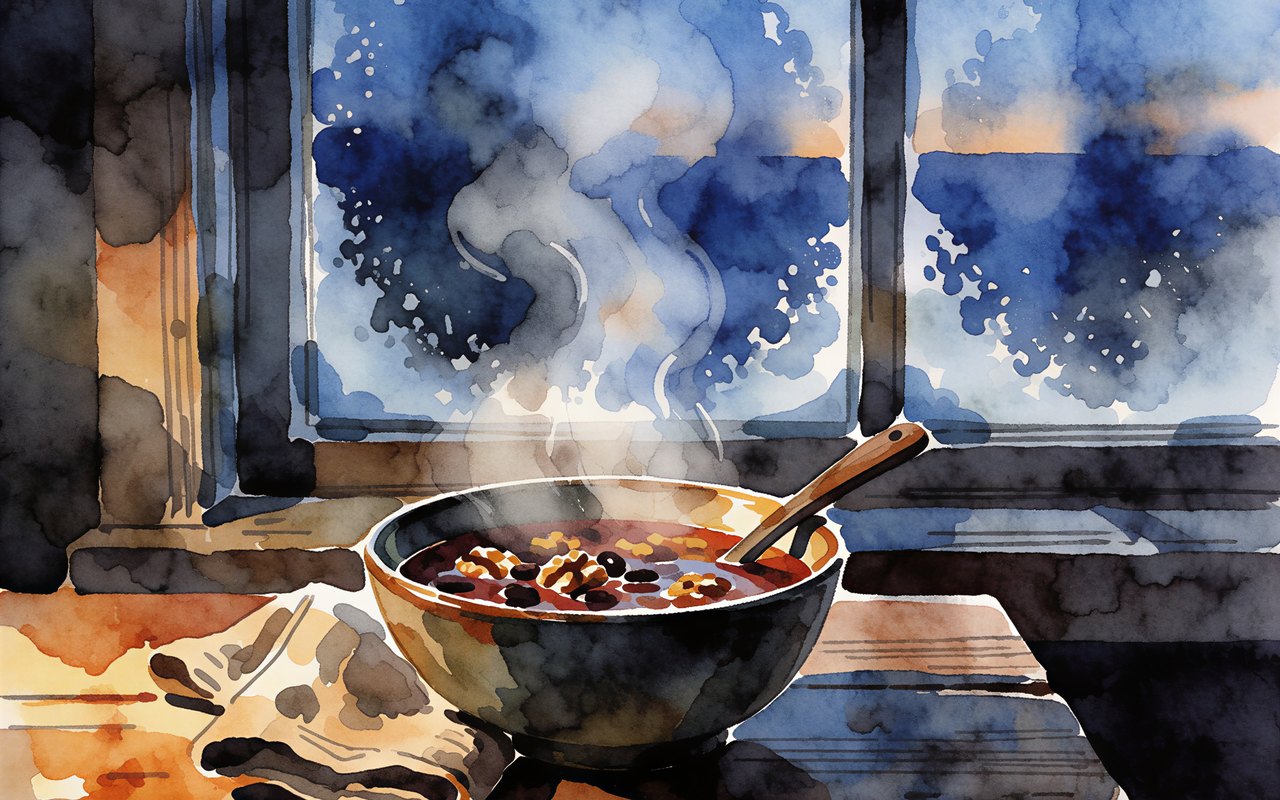
In China, winter congee — slow-cooked rice porridge with warming additions — is the season’s most fundamental breakfast. A basic winter version: slow-cook white or black rice in bone broth or water (1:8 ratio) for 1–2 hours. Add black sesame seeds, a few jujube dates, walnuts, and a pinch of cinnamon at the end. Eat warm, without distraction, between 7 and 9am during the Stomach’s peak. This single breakfast, eaten regularly through winter, supports the Kidney, nourishes Blood, warms the Yang, and provides the foundation for the day’s energy in a way that no cold smoothie can approach.
Acupressure for Winter Kidney Support
Kidney 3 — Taixi (Great Stream)
In the depression between the inner ankle bone (medial malleolus) and the Achilles tendon, level with the tip of the malleolus. Source point of the Kidney channel — used in TCM to nourish both Kidney Yin and Yang. Press for 2–3 minutes per side in the evening. Avoid pressing into the pulse of the posterior tibial artery.
Bladder 23 — Shenshu (Kidney Shu)

Two finger-widths (about 1.5 cun) from the midline at the level of the second lumbar vertebra. The Back-Shu point of the Kidney. Apply a warm pack or hot-water bottle here for about 15 minutes in the evening if it feels comfortable. Keep the skin safe from burns. This is a traditional warming practice for Kidney Qi in winter, not a treatment for diagnosed kidney disease.
The Inner Life of Winter
Winter’s inward quality supports the kind of inner work that the busy, outward seasons rarely allow. The darkness and stillness of winter create natural conditions for reflection, journaling, meditation, and the slow processing of the year’s experiences. In TCM, the Water element governs wisdom — not the quick intelligence of Fire or the creative planning of Wood, but the deep knowing that comes from time, patience, and the willingness to sit in the dark without forcing the light.
What winter asks of us is perhaps the thing modern culture finds most difficult: to stop, to conserve, to go inward, and to trust that the energy saved in stillness will become the vitality of spring. Every tradition that has lived close to the land has understood this. TCM simply provides the physiological framework for what the body already knows: rest now, and bloom later.
Related reading: The Kidney Meridian · The Bladder Meridian · The Earth Element · Moxibustion
Sources
Season, Water element, and Jing theory below are classical TCM teaching, not a biomedical diagnosis of the kidneys.
- Me & Qi — KI-3 Taixi (depression between medial malleolus and Achilles, level with the malleolar tip).
- Chinese Medicine Atlas — acupuncture points (KI-3, BL-23 at 1.5 cun / two finger-widths from the midline).
- Giovanni Maciocia, The Foundations of Chinese Medicine, 3rd ed. (Churchill Livingstone / Elsevier, 2015) — Jing, Water element, winter conservation.
- National Center for Complementary and Integrative Health, Traditional Chinese Medicine: What You Need To Know.
Disclaimer: This article is for informational purposes only and does not replace professional medical advice. Always consult a qualified healthcare provider before beginning any new wellness practice.