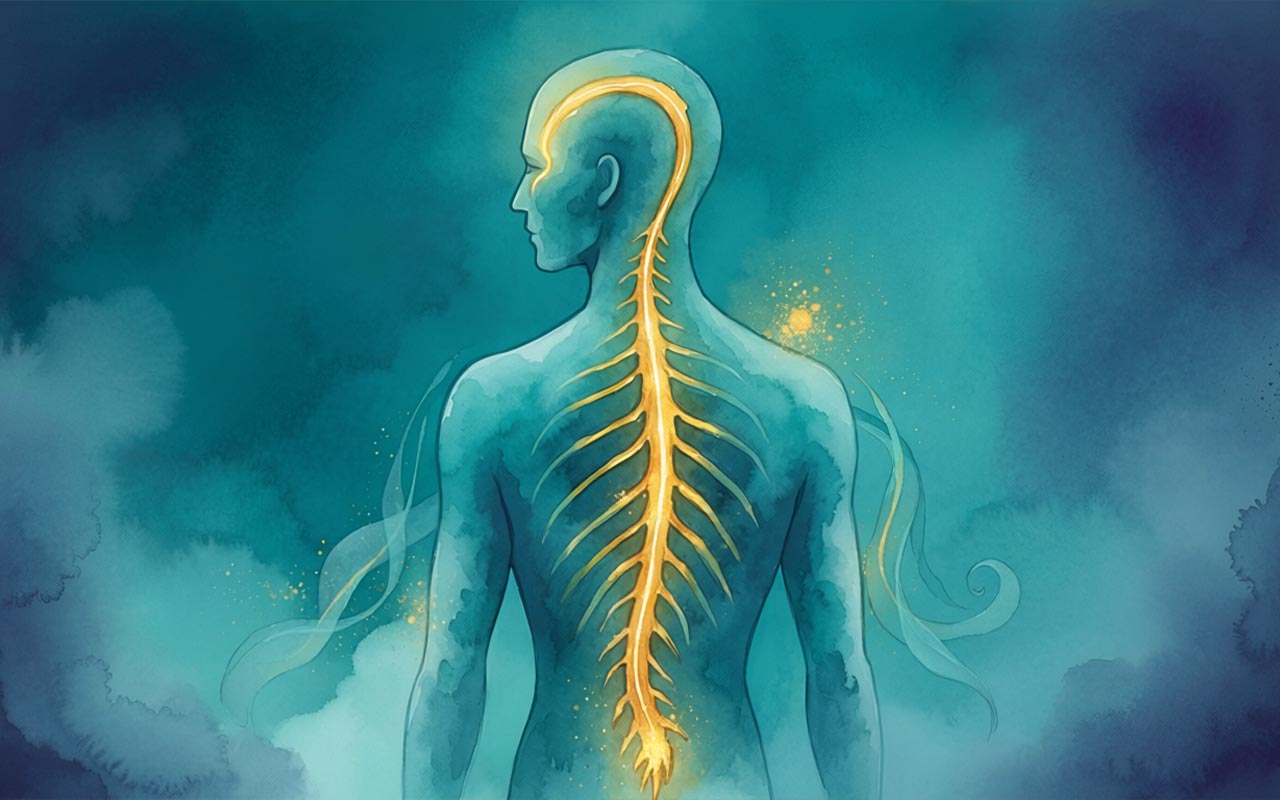
The Bladder Meridian is the longest meridian in the body — 67 points running from the inner corner of the eye, up and over the head, down the full length of the back in two parallel lines, and all the way to the outer corner of the little toenail. In Traditional Chinese Medicine, the Bladder is far more than a vessel for urine: it is the great reservoir of the body’s defensive energy, the organ most intimately connected to the nervous system through the back’s association points, and the Yang counterpart of the Kidneys — the organ of deep vitality and willpower. Understanding the Bladder Meridian is understanding the body’s spine, its defences, and its capacity to process and release fear.
The Bladder in Traditional Chinese Medicine
In the five-element framework of TCM, the Bladder belongs to the Water element — the same element as the Kidneys, its Yin partner. While the Kidneys store the deep essence (Jing) and govern the body’s fundamental vitality, the Bladder governs the transformation and excretion of fluids, and — crucially — the distribution of the body’s defensive Qi (Wei Qi) through its extensive back pathway.
The Bladder Meridian’s most clinically significant feature is the double row of Back-Shu points that run along its inner pathway on the back. These are the “associated points” — one for each major organ — where the Qi of the internal organs surfaces to the back. Treating these points directly influences the corresponding organs, making the Bladder Meridian’s back pathway the most comprehensive diagnostic and treatment zone in all of TCM. A skilled practitioner reading the tension, tenderness, and temperature of the back is essentially reading the state of the entire organ system.
The Bladder is most active between 3pm and 5pm according to the TCM organ clock — the mid-afternoon window when energy naturally begins its descent from the peak of midday Yang toward the Yin of evening. This is traditionally the optimal time for physical activity that uses the body’s defensive Yang energy, and a common window for the afternoon slump that TCM associates with Kidney-Bladder Qi depletion.
The Pathway of the Bladder Meridian
The Bladder Meridian (Zu Tai Yang — Foot Greater Yang) is the longest meridian in TCM, with 67 points spanning the entire posterior aspect of the body.
Its remarkable pathway:
- Begins at the inner corner of the eye at Bladder 1 (Jingming)
- Ascends the forehead and over the top of the skull
- Descends the back of the skull to the neck
- Splits into two parallel lines down the back — one 1.5 cun from the midline (inner line), one 3 cun from the midline (outer line)
- The inner line carries the Back-Shu (associated) points for all major organs
- Both lines descend through the lumbar region, sacrum and buttocks
- Continue down the posterior thigh and reunite at the back of the knee at Bladder 40 (Weizhong)
- Continue down the outer back of the calf
- Pass behind the outer ankle at Bladder 60 (Kunlun)
- End at the outer corner of the little toenail at Bladder 67 (Zhiyin)
This extensive back pathway explains why the Bladder Meridian is central to virtually every condition involving the back, spine, neck, and posterior leg. Low back pain, neck stiffness, headaches at the back of the head, sciatica, and hamstring tightness all involve the Bladder Meridian’s territory.
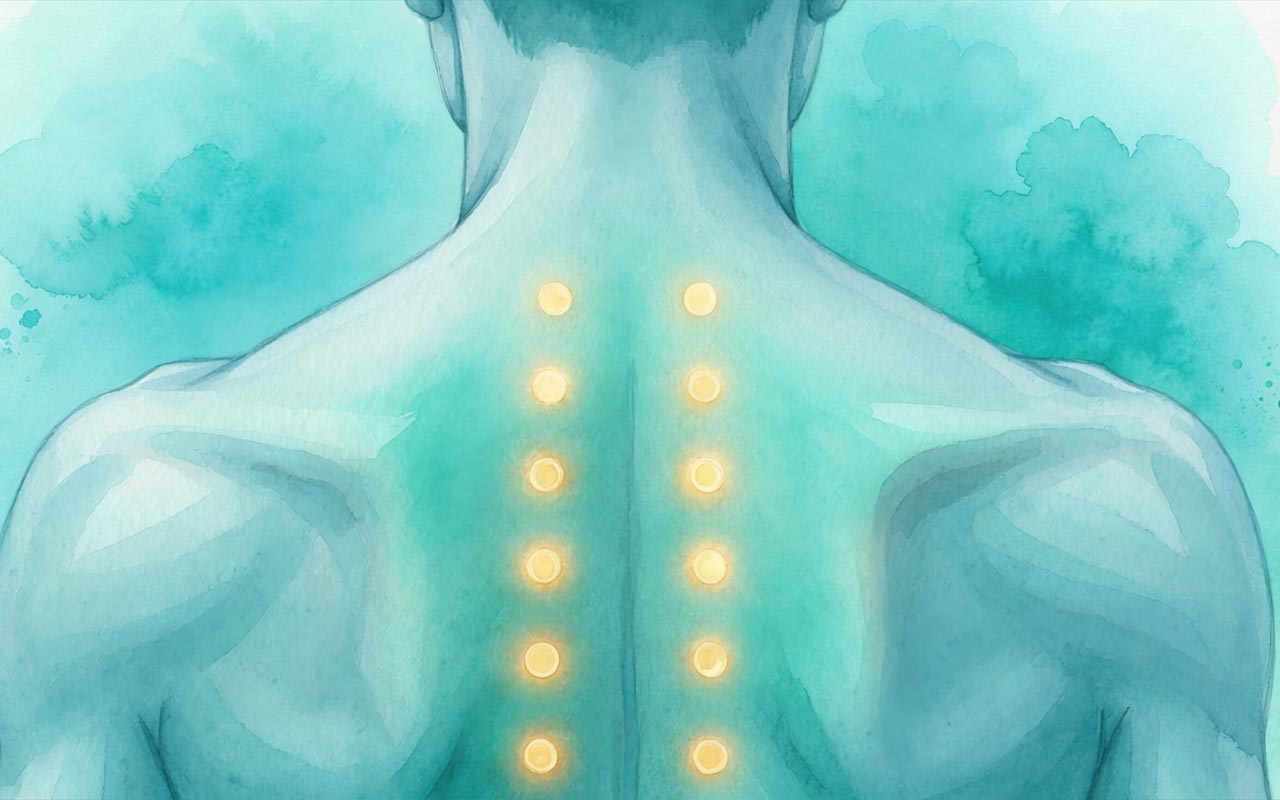
The Back-Shu Points — The Body’s Control Panel
The Back-Shu points are among the most important points in all of TCM. Located along the inner Bladder line, approximately 1.5 cun (about two finger-widths) from the midline of the spine, each point corresponds to a specific organ and directly influences its function:
- BL13 — Lung Shu (upper back, between shoulder blades)
- BL14 — Pericardium Shu
- BL15 — Heart Shu
- BL18 — Liver Shu (mid-back)
- BL19 — Gallbladder Shu
- BL20 — Spleen Shu
- BL21 — Stomach Shu
- BL23 — Kidney Shu (lower back, at the level of L2)
- BL25 — Large Intestine Shu
- BL27 — Small Intestine Shu (sacral region)
- BL28 — Bladder Shu
These points are simultaneously diagnostic and therapeutic. Tenderness at BL23 suggests Kidney deficiency. Tension at BL18 indicates Liver Qi stagnation. Tightness and cold at BL13 reflects Lung Qi deficiency or invasion by external cold. The back tells the whole story — which is why back massage, heat application, and Gua Sha along these points are among the most comprehensive TCM self-care interventions available.
What the Bladder Meridian Governs
- Fluid transformation and urination — the Bladder stores and excretes urine, and regulates water metabolism in its lower body function
- The entire back and spine — the meridian’s double pathway makes it responsible for the health of the entire posterior trunk
- The posterior head and neck — occipital headaches, stiff neck, and eye conditions are addressed through this channel
- The back of the leg — hamstring tightness, popliteal (behind-knee) pain, calf tension, and Achilles area issues all involve the Bladder Meridian
- Defensive Qi (Wei Qi) — the Bladder Meridian is the outermost Yang meridian and the first line of defence against external pathogenic factors; it is the channel most commonly affected by colds, flu, and acute illness
- Fear and the nervous system — shared with the Kidneys as a Water element function; the Bladder Meridian’s close relationship to the spine gives it a deep connection to the nervous system and the processing of fear and shock
Key Acupuncture Points on the Bladder Meridian
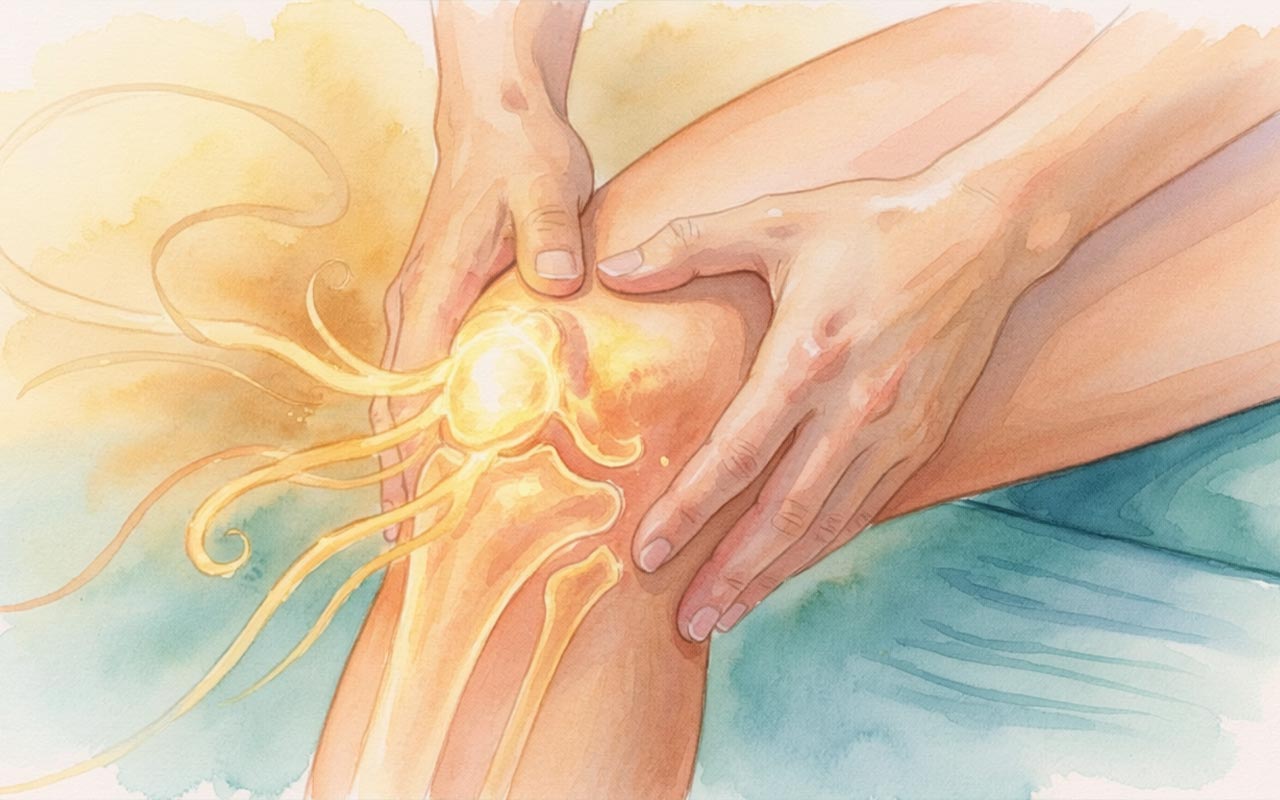
Bladder 40 — Weizhong (Commanding Middle)
Located at the centre of the popliteal crease — the fold behind the knee. One of the most important points in TCM, often called the command point of the back. Its classical indication is “all diseases of the lumbar region and back.” In TCM it is used for acute and chronic low back pain, sciatica, leg pain and weakness, and other conditions along this channel. For self-acupressure, press firmly into the centre of the back of the knee with both thumbs while the knee is slightly bent. It is also used in TCM to clear Heat and for some skin patterns. Effects vary; it is not a substitute for assessment of serious back pain.
Bladder 60 — Kunlun (Kunlun Mountain)
Located in the depression between the outer ankle bone and the Achilles tendon — the mirror image of Kidney 3 on the opposite side of the ankle. Named after China’s most sacred mountain range, Kunlun is used for headaches (especially at the back of the head), neck stiffness, low back pain, sciatica, and any condition along the posterior of the body. It is also the Fire point of the Water meridian — a paradoxical combination that gives it a strong moving and dispersing action, particularly for pain and stagnation along the back. Note: contraindicated during pregnancy, as it strongly moves Qi downward and can stimulate labour.
Bladder 23 — Shenshu (Kidney Shu)
Located 1.5 cun lateral to the lower border of the second lumbar vertebra (L2) — approximately at waist level, two finger-widths from the midline. This is the Back-Shu point of the Kidneys — one of the most important points on the entire body for Kidney deficiency, low back pain, reproductive health, and the deep fatigue of depleted Jing. Warming this point with a hot water bottle, moxa, or simply firm palm pressure for several minutes is one of the most accessible and effective ways to nourish the Kidneys and relieve lower back ache.
Bladder 10 — Tianzhu (Celestial Pillar)
Located at the base of the skull, approximately 1.3 cun lateral to the midline in the depression lateral to the trapezius muscle. One of the primary points for occipital headaches, neck stiffness, and the heavy-headed feeling of fatigue or illness. Pressing both BL10 points simultaneously — along with GB20 directly lateral to them — creates one of the most effective acupressure combinations for releasing tension from the entire posterior skull and upper neck.
Daily Practices to Support the Bladder Meridian
1. The Full Back Self-Massage
Because the Bladder Meridian runs the entire length of the back, a systematic self-massage of the back — using a tennis ball, a foam roller, or simply firm palm pressure — directly stimulates the entire meridian and all its Back-Shu points simultaneously.
Tennis ball technique: place a tennis ball between your back and a wall. Starting at the upper back (BL13 zone, between the shoulder blades), slowly roll the ball down the inner Bladder line on each side of the spine, pausing and applying pressure wherever you find tenderness. Continue all the way down to the sacral region. This takes about 5–7 minutes per side. In TCM, tenderness along this line is read as information about the corresponding Back-Shu organ — a teaching aid for practitioners, not a self-diagnosis of disease. Stop if pain is sharp, radiates, or follows injury.
2. Warm the Lower Back (BL23)
The Kidney Shu points at BL23 are among the most commonly deficient and most easily supported points in the body. Simply applying warmth to the lower back — a hot water bottle, a heated pad, or moxa — for 10–15 minutes nourishes Kidney Qi through the Bladder Meridian. This is particularly valuable in cold weather, in the evening before sleep, or any time you feel the deep fatigue, low back ache, or cold lower extremities that indicate Kidney-Bladder depletion.
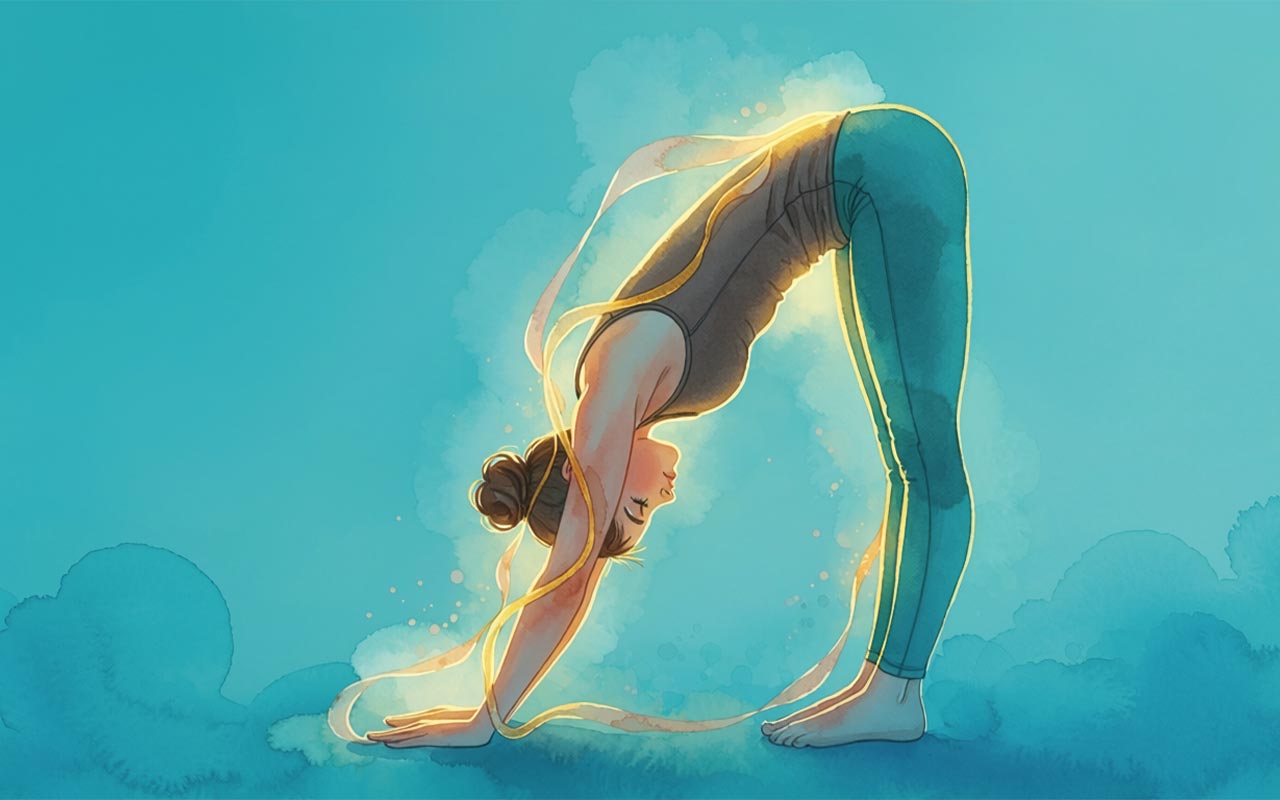
3. Forward Fold — Stretching the Entire Posterior Chain
A slow, sustained forward fold — standing or seated — stretches the entire posterior chain of the body: the hamstrings, calves, lower back, and up the Bladder Meridian’s pathway. In yin yoga, postures like the sleeping swan, caterpillar (seated forward fold), and snail directly target this channel with sustained, deep opening.
Hold each pose for 3–5 minutes, breathing slowly. The sustained duration allows the connective tissue and fascial layers — where the Bladder Meridian is believed to operate — to release progressively. Many people notice a profound sense of release and calming after sustained posterior chain opening, reflecting the Bladder Meridian’s connection to the nervous system and the processing of held tension.
4. Press BL40 for Back Pain Relief
Find the centre of the back of your knee — in the middle of the popliteal crease. Using both thumbs, press firmly into this point while the knee is very slightly bent. Hold for 1–2 minutes per side, breathing slowly. In TCM, BL40 is the command point of the back; some people feel easing of low-back tension, others less so. This point can be pressed after long sitting or heavy work. Seek care for sudden, severe, or radiating pain, or pain after trauma.
5. Stay Hydrated — Supporting the Water Element
The Bladder’s physiological function depends on adequate hydration — and the Water element more broadly is nourished by appropriate fluid intake. TCM recommends warm or room-temperature water rather than cold, particularly during colder months and for those with Kidney or Bladder deficiency patterns. Herbal teas supportive of the Water element include: nettle (nourishing and mineral-rich), corn silk (supports urinary function), and horsetail (strengthens connective tissue and supports the kidney system).
Final Thoughts: The Body’s Longest Journey
The Bladder Meridian travels further than any other — from the inner eye to the outer little toe, covering the entire posterior surface of the body and carrying within its back pathway a map of every major organ. Tending to this meridian is, in a real sense, tending to the whole body.
Roll the back along the Bladder line. Warm the lower back. Press BL40 when tension builds. Stretch the posterior chain with patience. Stay hydrated. These are the Bladder Meridian’s invitations — vast in reach, simple in practice, and comprehensive in their effect on everything the back pathway touches.
Related reading: Understanding Meridians · The Kidney Meridian · The Eight Extraordinary Meridians · What Is Qigong?
Sources
Point locations and organ theory follow classical TCM teaching; they are not a biomedical diagnosis.
- Me & Qi — Bladder Meridian (Foot Taiyang) — pathway, 67 points, Back-Shu line, BL-40 as command point of the back.
- Chinese Medicine Atlas — Twelve primary meridians; acupuncture points reference (including BL-60, forbidden in pregnancy).
- Giovanni Maciocia, The Foundations of Chinese Medicine, 3rd ed. (Churchill Livingstone / Elsevier, 2015).
- National Center for Complementary and Integrative Health, Traditional Chinese Medicine: What You Need To Know; Acupuncture: Effectiveness and Safety.
Disclaimer: This article is for informational purposes only and does not replace professional medical advice. Always consult a qualified healthcare provider before beginning any new wellness practice.
Images on this page are AI-generated (Adobe Firefly), used purely for illustration and do not depict real people.