Of all the twelve primary meridians, the Pericardium Meridian may be the least familiar — and yet it is one of the most practically important for modern life. It is the meridian of the heart’s protector: the physiological membrane around the heart that shields it from physical harm, and the energetic boundary that protects the heart’s spirit — the Shen — from emotional overwhelm. In a world of relentless connection, constant demands on our emotional availability, and unprecedented levels of stress, the Pericardium’s function has never been more relevant.
The Pericardium in Traditional Chinese Medicine
In TCM, the Pericardium (also called the Heart Protector or Heart Governor, or in Chinese: Xin Bao) is considered the sixth Yin organ — though it is unique in having no parallel in Western anatomy beyond the physical membrane that surrounds the heart. Its role is fundamentally protective: it stands guard around the Emperor (the Heart) and ensures that nothing harmful reaches the heart’s spirit.
The Pericardium belongs to the Fire element, the same element as the Heart. While the Heart governs the overall quality of the Shen — consciousness, awareness, joy, and the capacity for genuine connection — the Pericardium governs the interface between the heart and the world: how we open to intimacy, how we protect ourselves from emotional harm, and how we regulate the flow of emotional energy in our relationships.
Its Yang partner is the Triple Burner (San Jiao) — together they form the second Fire pair, complementing the Heart-Small Intestine partnership. The Pericardium’s peak time on the TCM organ clock is 7pm to 9pm — the evening hours traditionally associated with intimate connection, unwinding after the day’s activities, and the transition from outward engagement to inward rest.
The Pathway of the Pericardium Meridian
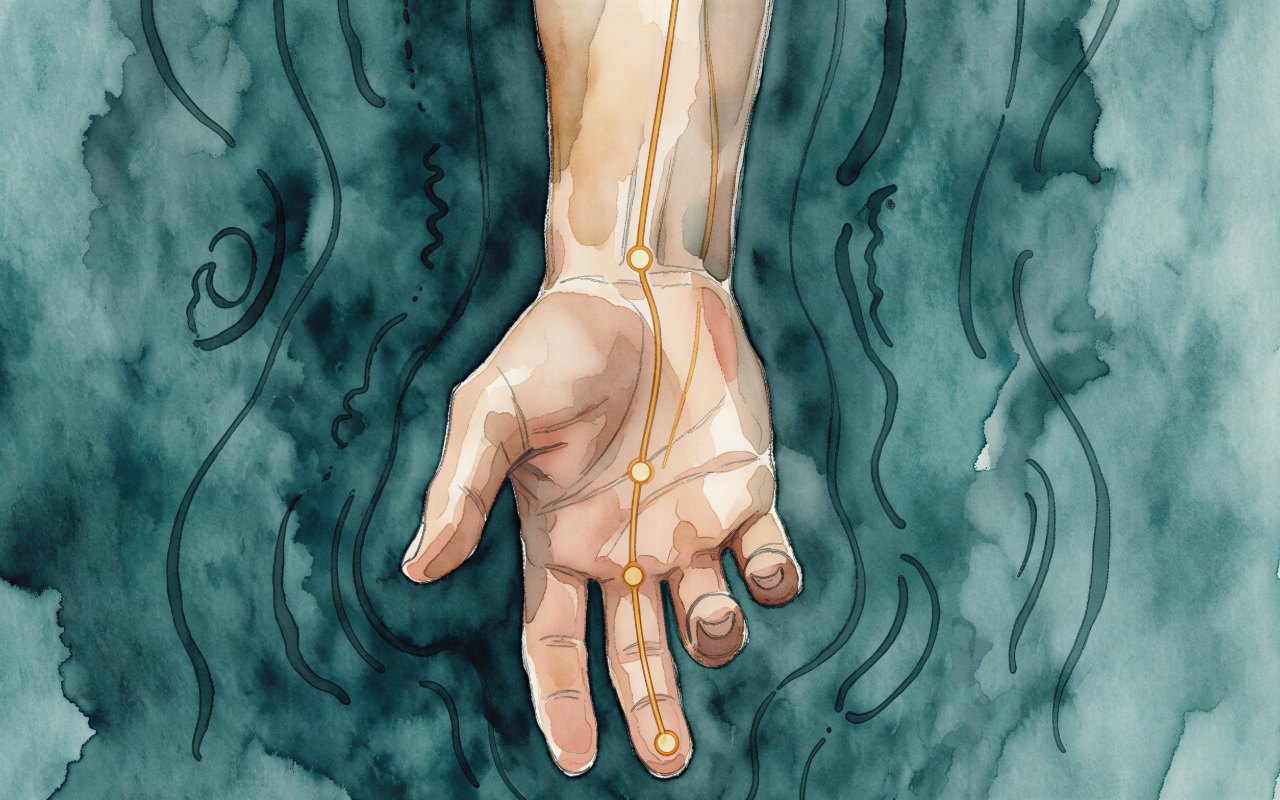
The Pericardium Meridian (Shou Jue Yin — Hand Absolute Yin) runs from the chest down the inner arm to the middle finger. With 9 points, it is one of the shorter meridians, but each point is clinically significant.
Its pathway:
- Begins in the chest at Pericardium 1 (Tianchi), lateral to the nipple
- Ascends to the axilla (armpit) and then descends down the inner arm
- Runs along the centre of the inner forearm between the Lung and Heart Meridians
- Passes through the wrist at Pericardium 6 (Neiguan) and Pericardium 7 (Daling)
- Continues through the palm
- Ends at the tip of the middle finger at Pericardium 9 (Zhongchong)
The meridian’s pathway along the inner arm — between the Lung and Heart channels — reflects its role as mediator between breath (Lung) and spirit (Heart). Its wrist points are among the most frequently used in all of acupuncture practice.
What the Pericardium Meridian Governs
- Protection of the Heart and Shen — the Pericardium acts as the heart’s guardian, preventing harmful emotional and physical influences from reaching the heart directly
- Emotional regulation in relationships — governs the capacity to open and close emotionally; to be intimate without being overwhelmed; to protect without becoming closed
- Joy and pleasure — as a Fire element organ, the Pericardium shares in the Heart’s joy; it governs the capacity for playfulness, delight, and genuine pleasure
- The chest and heart region — palpitations, chest tightness, and chest pain are addressed through the Pericardium Meridian
- The stomach and nausea — through its connection to the Triple Burner and its Qi-moving function, the Pericardium influences the upper digestive system; PC6 is the best-studied acupressure point for nausea; a Cochrane review found that stimulating it can reduce nausea after surgery
- Sleep and the mind at night — because the Pericardium’s peak time is in the evening, it has a significant influence on the quality of the transition to sleep and the settling of the Shen at night
The Art of Emotional Protection
The Pericardium’s most distinctive and practically important function is the regulation of emotional boundaries — the capacity to open and close the heart appropriately in response to different people and situations.

When Pericardium function is healthy, there is a natural fluidity: we open to those we trust, allow intimacy with those we love, engage with warmth in social situations, and close appropriately when protection is needed — without becoming either chronically defended or chronically porous. This is one of the most sophisticated forms of emotional intelligence, and one of the most difficult to maintain in a world that constantly demands emotional availability.
When Pericardium function is disrupted, two opposite patterns emerge:
- Excessive openness — the person is too easily affected by others’ emotions, lacks the ability to maintain healthy boundaries, absorbs other people’s pain and suffering, feels overwhelmed in social situations, and cannot distinguish their own feelings from those around them. This is the pattern of empaths who burn out, caregivers who give too much, and people who consistently find themselves in one-sided relationships.
- Excessive closure — the person has built such strong protective walls around the heart that genuine intimacy becomes impossible. They may appear cold, disconnected, or emotionally unavailable — not from lack of feeling, but from the accumulated scar tissue of emotional injury. The Pericardium has closed so thoroughly that it cannot easily open again.
Both patterns represent Pericardium dysfunction — and both are recognisable in modern clinical practice. Working with the Pericardium Meridian, whether through acupuncture, acupressure, or the practices described below, helps restore the natural fluidity between openness and protection.
Signs of Pericardium Meridian Imbalance
Pericardium Qi or Blood Deficiency
- Heart palpitations — a fluttering or racing sensation in the chest
- Anxiety, particularly in social situations or intimate relationships
- Difficulty sleeping — an unsettled, restless quality at night
- Emotional sensitivity — being easily hurt or overwhelmed by others
- Difficulty maintaining appropriate emotional boundaries
Pericardium Fire (excess heat)
- Strong palpitations or a racing heart
- Agitation and restlessness — particularly in the evening
- Insomnia with vivid, disturbing dreams
- Inappropriate or excessive laughter — a TCM sign of Heart-Pericardium Fire
- A red face or flushed sensation in the chest and face
Phlegm Misting the Pericardium
- Mental confusion, cloudiness, or disconnection from one’s emotional experience
- Emotional numbness — the inability to access or express feelings
- In severe cases: manic or psychotic episodes, as the Shen becomes disturbed
Key Acupuncture Points on the Pericardium Meridian
Pericardium 6 — Neiguan (Inner Gate)
Located on the inner forearm, three finger-widths above the wrist crease, between the two prominent tendons (palmaris longus and flexor carpi radialis). This is the most important point on the Pericardium Meridian — and one of the most researched acupuncture points in the world. It is called “Inner Gate” because it is the opening to the interior of the chest and heart region.
PC6 is the master point of the Yin Wei Mai (Yin Linking Vessel), which connects all Yin meridians — making it one of the most tonifying and harmonising points in the entire system. It is used for heart palpitations, chest tightness, anxiety, nausea (it is the point behind acupressure wristbands for motion sickness), insomnia, and emotional disturbance. It calms the Shen, opens the chest, and regulates the stomach. Simply pressing this point firmly for two to three minutes on each wrist at the end of a stressful day is noticeably calming for many people.
Pericardium 7 — Daling (Great Mound)
Located at the centre of the wrist crease, between the two tendons. This is the source point and the Earth point of the Fire meridian — a powerful combination for grounding excess Fire and calming the Shen. In TCM it is used for anxiety, palpitations, insomnia, and mental restlessness, and for wrist pain, as it sits directly over the carpal tunnel. Palpitations and persistent tingling or numbness in the hand (for example carpal tunnel syndrome) should be checked by a doctor. For anyone who works extensively with their hands — musicians, writers, programmers — regular attention to this point supports both the physical and energetic health of the wrist.
Pericardium 8 — Laogong (Palace of Labour)
Located in the centre of the palm, between the second and third metacarpal bones, where the middle finger touches when you make a loose fist. This is a Fire point on the Fire meridian — intensely clearing for Heart-Pericardium heat. It is used for emotional agitation, excessive body heat, mouth ulcers from Heart Fire, and as an emergency point to revive consciousness. In Qigong practice, the Laogong point is considered a primary energy emission point — where Qi exits and enters the body through the palms. Practices like palm healing and external Qi Gong work directly with this point.
Daily Practices to Support the Pericardium Meridian
1. Press PC6 (Neiguan) to Calm and Centre
Find the point three finger-widths above the wrist crease on the inner forearm, between the two tendons. Using the thumb of your opposite hand, press firmly — the point is often noticeably sensitive, particularly during stress or emotional agitation. Hold the pressure or make small circles for two to three minutes per wrist, breathing slowly and deeply.
This is one of the simplest acupressure practices for a moment of calm. Many people notice a quieting of the chest and a slowing of the breath within minutes. It can be practiced anywhere — on public transport, before a difficult conversation, during a moment of overwhelm. The acupressure wristbands sold for motion sickness work on exactly this point.
2. The Evening Wind-Down — Honouring the Pericardium’s Time
The Pericardium is most active between 7pm and 9pm. Traditionally, this was the time for intimate connection — family dinner, conversation with loved ones, gentle unwinding after the day. In modern life, this window is often filled with screens, work overflow, and stimulation that keeps the Shen agitated past the point where it can settle into sleep.
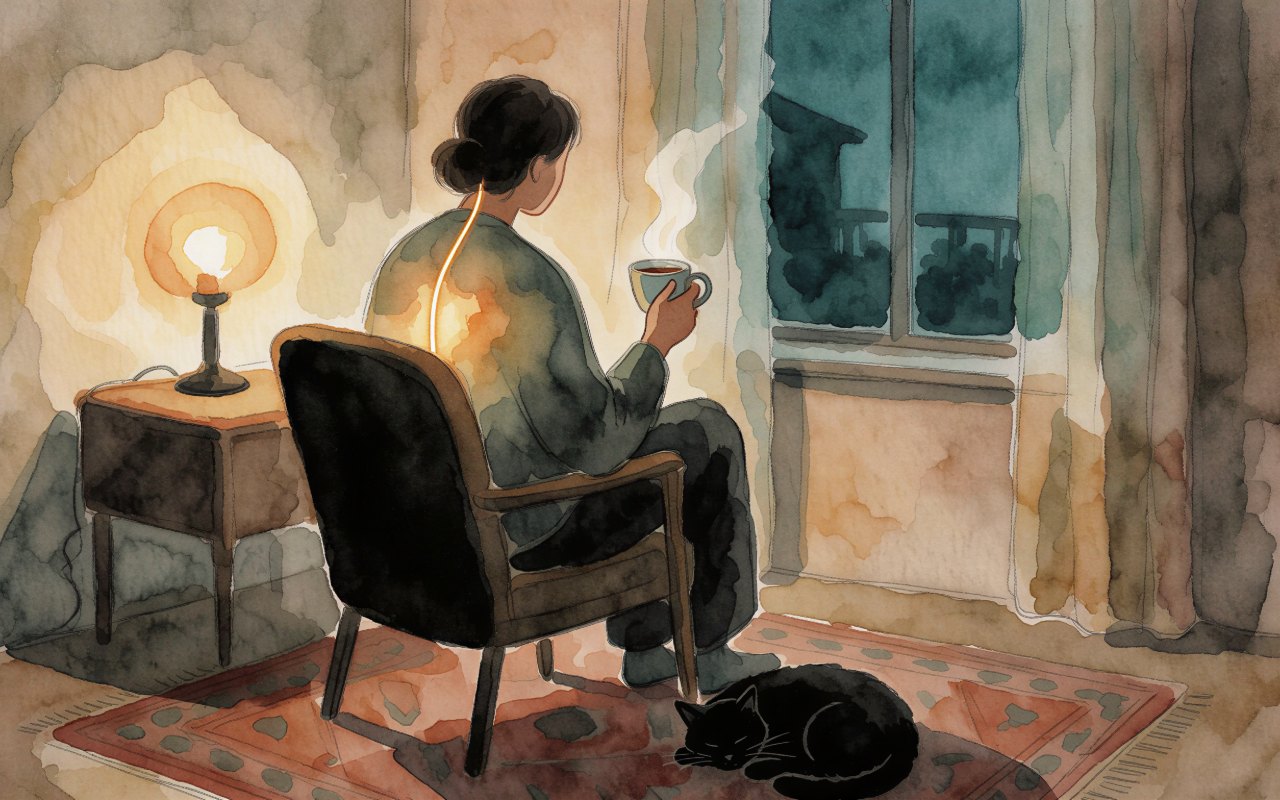
A Pericardium-supportive evening practice: between 7pm and 9pm, consciously shift from screens and outward engagement toward warmth, connection, and gentle inwardness. Light a candle. Have a warm conversation. Read something that nourishes rather than stimulates. This is not asceticism — it is alignment with the body’s natural rhythm, and many people find that it helps them settle into sleep when practised consistently.
3. Chest-Opening Practices
The Pericardium Meridian runs through the chest, and its function is directly supported by practices that open and release tension in the chest cavity — the physical home of the heart and its protector.
Simple practices: gentle backbends (yoga’s fish pose or bridge pose), chest-opening stretches with arms spread wide and the sternum lifted, or simply sitting tall with the shoulders rolled back and down, taking five slow, full breaths that expand the chest completely. Many people carry enormous tension in the chest without being aware of it — the physical act of opening creates a corresponding emotional release.
4. Laogong Palm Meditation
Sit quietly. Hold your hands in front of you, palms facing each other, about thirty centimetres apart. Breathe slowly and bring your attention to the centre of each palm — the Laogong points. As you inhale, slowly bring the palms closer together without touching. As you exhale, allow them to drift apart. Continue for five to ten minutes, noticing any sensations — warmth, tingling, a magnetic quality — between the palms.
This is a classic Qigong practice for activating the Pericardium Meridian and building sensitivity to Qi. Over time, it develops a tangible awareness of energy in the hands that informs and enhances all other energy work.
5. Cultivating Appropriate Emotional Boundaries
Because the Pericardium governs emotional boundaries, the most profound work with this meridian is often not physical but relational. Reflecting honestly on your own patterns — am I too open, absorbing others’ pain and losing myself? Or am I too closed, protecting the heart so thoroughly that genuine connection becomes rare? — is the first step.
Practices that support the Pericardium’s boundary function: learning to identify when you feel emotionally overwhelmed and consciously creating space (physical, temporal, or energetic) rather than pushing through; practising the sentence “I need some time alone” without guilt; and equally, practising the deliberate lowering of the Pericardium’s guard with trusted people — allowing yourself to be seen, to receive, to be held without immediately needing to give or perform.
The Pericardium and Modern Emotional Life
The Pericardium’s challenges are quintessentially modern. We live in a time of unprecedented demands on emotional availability: social media creates the expectation of continuous openness and response; professional environments expect emotional engagement without providing protection for it; intimate relationships are navigated without the cultural frameworks that once provided structure. The result is a Pericardium under chronic stress — oscillating between defensive closure and exhausted over-openness, rarely finding the fluid middle ground that genuine relational health requires.
Working with the Pericardium Meridian — whether through acupressure on PC6, the evening wind-down practice, chest-opening movement, or the deeper work of reflecting on relational patterns — is one of the most relevant things contemporary TCM practice offers. The heart needs its protector. And the protector needs tending.
Final Thoughts: Guard the Gate
The Pericardium Meridian teaches a subtle and essential art: the capacity to be genuinely open and genuinely protected at the same time — not as opposites, but as a fluid, responsive balance. The Inner Gate (PC6) is a gate, not a wall: it can open and close. The practitioner’s work — and the work of anyone who tends to this meridian — is to keep that gate functional: neither jammed open nor permanently locked shut.
Press PC6 each evening. Create space in the hours before sleep. Open the chest with intention. And tend to the relational patterns that either deplete or nourish the heart’s guardian. The Emperor’s minister is worth protecting too.
Related reading: Understanding Meridians · The Heart Meridian · The Small Intestine Meridian · The Lung Meridian · What Is Qigong?
Sources
Meridian pathways, organ-clock times and point locations follow classical TCM teaching; they are not a biomedical diagnosis.
- Me & Qi — Neiguan PC-6 (2 cun above the wrist crease, between the tendons of palmaris longus and flexor carpi radialis).
- Giovanni Maciocia, The Foundations of Chinese Medicine, 3rd ed. (Churchill Livingstone / Elsevier, 2015).
- National Center for Complementary and Integrative Health, Traditional Chinese Medicine: What You Need To Know.
- Me & Qi: Daling PC-7 (location and classical indications).
- Lee A, Chan SK, Fan LT, Stimulation of the wrist acupuncture point PC6 for preventing postoperative nausea and vomiting, Cochrane Database of Systematic Reviews 2015.
- Lim S, WHO Standard Acupuncture Point Locations, Evidence-Based Complementary and Alternative Medicine 2010 (overview of the WHO standard for the 361 classical points).
- NCCIH, Acupuncture: Effectiveness and Safety.
Disclaimer: This article is for informational purposes only and does not replace professional medical advice. Chest pain, palpitations or persistent anxiety should always be checked by a doctor. Consult a qualified healthcare provider before beginning any new wellness practice.