If the Stomach receives and ripens, the Spleen transforms and transports. These two Earth element organs work as an inseparable pair — and of the two, the Spleen is considered the more fundamental. It is the Spleen that takes what the Stomach has broken down and converts it into the Qi, Blood, and fluids the body needs to live. Without strong Spleen function, nothing the Stomach produces can be properly used. This is why in TCM, “strengthening the Spleen” is one of the most common clinical interventions — and one of the most practically transformative things a person can do for their long-term health.
The Spleen in Traditional Chinese Medicine
In the five-element framework of TCM, the Spleen belongs to the Earth element — the same element as the Stomach, its Yang counterpart. As the Yin organ of the pair, the Spleen has a deeper, more fundamental role: it is the primary source of postnatal Qi and Blood. Everything the body needs to maintain life — the energy to breathe, think, move, and heal — ultimately traces back to the Spleen’s transformative function.
The Spleen’s two core functions in TCM are:
- Transformation — converting food and drink into usable Qi and Blood
- Transportation — distributing that Qi and Blood throughout the body, upward to the Lungs and Heart, and outward to the muscles and limbs
When the Spleen performs these functions well, the body has abundant energy, clear thinking, strong muscles, and a reliable appetite. When Spleen function is compromised — by poor diet, overthinking, cold foods, overwork, or dampness — the result is fatigue, mental fog, bloating, loose stools, weight gain, and the accumulation of Phlegm-Dampness throughout the body.
The Spleen is also responsible for holding things in place — keeping Blood within the vessels (preventing easy bruising and bleeding), keeping organs in their proper position (preventing prolapse), and keeping the body’s fluids in proper circulation rather than accumulating as pathological dampness. This “holding” function is central to the Spleen’s role in TCM physiology.
The Pathway of the Spleen Meridian
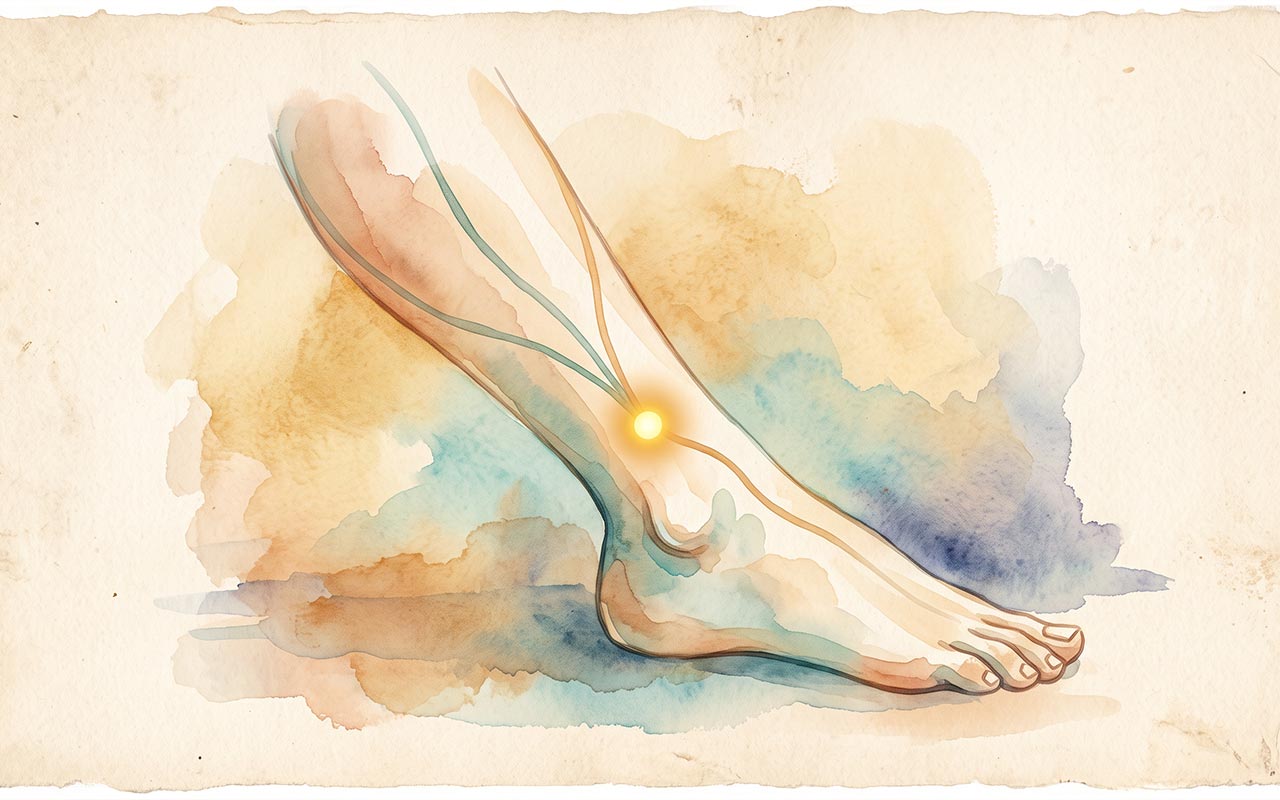
The Spleen Meridian (Zu Tai Yin — Foot Greater Yin) begins on the inner side of the big toe and travels up the inner leg and thigh into the abdomen and chest. With 21 points, it forms the Yin counterpart to the Stomach Meridian’s Yang pathway.
Its pathway:
- Begins at Spleen 1 (Yinbai) at the inner corner of the big toenail
- Travels along the inner edge of the foot and up the inner ankle
- Ascends along the inner leg, crossing in front of the Liver Meridian on the lower leg (about 8 cun above the inner ankle), then continues past the inner knee
- Continues up the inner thigh into the groin
- Enters the abdomen and connects internally to the spleen and stomach organs
- Ascends through the chest, passing alongside the esophagus
- An internal branch reaches the root of the tongue; the last numbered point on the surface is Spleen 21 (Dabao) on the mid-axillary line of the chest
- A branch spreads across the chest and connects to the Heart Meridian
The Spleen Meridian is most active between 9am and 11am according to the TCM organ clock — the hours immediately following the Stomach’s peak time. This is when the Spleen is at maximum capacity for transforming and distributing the nourishment from breakfast, making it an optimal time for focused mental work that requires good Qi and Blood supply to the brain.
The Spleen Meridian’s pathway along the inner leg and ankle explains why Spleen imbalance frequently manifests as inner knee pain, ankle swelling, and edema in the lower extremities. Its connection to the tongue explains why a pale, swollen, or tooth-marked tongue (one that shows the impressions of the teeth at its edges) is a classic sign of Spleen Qi deficiency in TCM diagnosis.
What the Spleen Meridian Governs
- Transformation and transportation of food essence — the primary function; converts digested food into Qi and Blood and distributes it
- Production of Blood — the Spleen is the primary producer of Blood in TCM; Spleen deficiency leads to Blood deficiency
- Holding Blood in the vessels — prevents easy bruising, excessive menstrual bleeding, and other forms of Blood escaping its channels
- The muscles and four limbs — Spleen Qi nourishes the muscles; deficiency causes weakness, heaviness, and fatigue in the limbs
- The mouth and lips — the Spleen opens to the mouth; pale, dry lips indicate Spleen Blood deficiency
- Fluid metabolism — the Spleen governs the transformation and movement of fluids; dysfunction leads to Dampness, Phlegm, and edema
- Holding organs in place — Spleen Qi deficiency can lead to organ prolapse, hemorrhoids, and varicose veins
- The Yi — the mind of the Spleen — associated with thought, intention, and the capacity for focused concentration
Dampness, Phlegm, and the Modern Epidemic
One of the Spleen’s most clinically significant functions is its role in fluid metabolism. When the Spleen is functioning well, fluids are transformed, transported, and eliminated appropriately. When it is weak — particularly from cold foods, raw foods, overwork, or overthinking — fluids begin to accumulate as Dampness.
Dampness in TCM is a heavy, sticky, obstructive pathological substance that settles in the body and impairs the free flow of Qi and Blood. Over time, Dampness can congeal into Phlegm — an even more stubborn form of obstruction that can accumulate in the lungs (producing mucus and cough), in the vessels (contributing to atherosclerosis in Western terms), in the joints (producing stiff, heavy joints), or in the mind (producing the classic “foggy head” of Phlegm-Misting-the-Heart).
This pattern — Spleen Qi deficiency leading to Dampness and Phlegm — is considered one of the most prevalent pathological conditions in modern clinical TCM. The combination of sedentary lifestyles, cold and raw diets (smoothies, salads, cold drinks), excessive sweet foods, and chronic stress creates ideal conditions for Spleen dysfunction. The resulting symptoms — chronic fatigue, mental fog, weight that is difficult to lose, bloating, loose stools, and a persistent feeling of heaviness — are epidemic in modern populations.
Signs of Spleen Meridian Imbalance
Spleen Qi Deficiency (most common pattern)
- Chronic fatigue, especially after eating
- Poor appetite, or appetite that is erratic
- Abdominal bloating and distension after meals
- Loose stools or diarrhea — especially in the morning
- Weakness and heaviness in the limbs
- A pale, swollen tongue with tooth marks at the edges
- A weak, soft pulse
- Difficulty concentrating; mental fog
Spleen Qi Deficiency with Dampness
- All of the above, plus:
- A persistent feeling of heaviness in the body and head
- Edema — swelling in the legs, ankles, or face, especially in the morning
- Weight that is difficult to lose despite eating carefully
- Excessive mucus or phlegm
- A thick, greasy tongue coating
- Skin conditions involving dampness — eczema, weeping lesions, fungal infections
Spleen Unable to Hold Blood
- Easy bruising
- Heavy menstrual periods or breakthrough bleeding
- Blood in the urine or stool
- Varicose veins or hemorrhoids
Key Acupuncture Points on the Spleen Meridian
Spleen 6 — Sanyinjiao (Three Yin Intersection)
Located four finger-widths (about 3 cun) above the inner ankle bone, just behind the shinbone. This is arguably the most important point on the Spleen Meridian — and one of the most frequently used points in all of TCM acupuncture. It is called “Three Yin Intersection” because it is the meeting point of three Yin meridians: the Spleen, Liver, and Kidney. This convergence makes it extraordinarily versatile: it tonifies Spleen Qi, nourishes Liver Blood, strengthens Kidney Yin and Yang, regulates the uterus, calms the mind, and promotes sleep. It is used for virtually every pattern involving the Earth, Wood, or Water elements.
Important note: SP6 is contraindicated during pregnancy, as it has a strong downward-moving and uterus-stimulating action. Pregnant women should not press this point.
Spleen 9 — Yinlingquan (Yin Mound Spring)
Located in the depression on the inner side of the knee, just below and behind the rounded prominence of the tibia. This is the Water point on the Spleen Meridian and the primary point for resolving Dampness from the lower body. It transforms Damp-Heat, benefits the bladder, and is used for edema, difficulty urinating, lower abdominal pain, and knee pain along the inner aspect. When the legs feel heavy, swollen, or waterlogged, SP9 is the most direct intervention.
Spleen 10 — Xuehai (Sea of Blood)
Located on the inner thigh, approximately two finger-widths above the upper inner corner of the kneecap. Its name — “Sea of Blood” — reflects its primary function: invigorating and nourishing Blood. It is used for menstrual irregularities, skin conditions involving Blood heat or Blood stasis (eczema, psoriasis, urticaria), and any condition where Blood is stagnant or insufficient. It is one of the most commonly used points in gynecology in TCM.
Spleen 3 — Taibai (Supreme White)
Located on the inner side of the foot, in the depression just behind the head of the first metatarsal bone. This is the source point and the Earth point of the Earth meridian — making it doubly connected to Earth element qualities. It directly tonifies Spleen Qi, transforms Dampness, and is particularly effective for digestive weakness, heavy limbs, and bloating. In self-acupressure, pressing this point along with SP6 creates a powerful combination for building Spleen Qi.
Daily Practices to Strengthen the Spleen Meridian
1. Press Spleen 6 Daily — The Three Yin Intersection
Find the point four finger-widths (about 3 cun) above the inner ankle bone, just behind the shinbone. Using your thumb, apply firm, steady pressure for 2–3 minutes per side, breathing slowly. This is one of the most powerful self-care points in TCM — regularly pressing SP6 tonifies Spleen, Liver, and Kidney simultaneously, improving energy, digestion, sleep quality, and emotional balance. Practice morning or evening, or any time you feel fatigued, heavy, or mentally foggy. Not for use during pregnancy.
2. Eat Warm, Cooked Foods — Protect the Spleen’s Yang
The Spleen is described as inherently “warm” in TCM — it needs warmth to transform food efficiently. Cold and raw foods require the Spleen to use extra energy to “warm” them before they can be processed, gradually depleting its capacity. This is why TCM consistently recommends warm, cooked foods as the foundation of a Spleen-supportive diet.
Practical changes that make a significant difference: switching from cold smoothies to warm oatmeal or congee at breakfast; replacing cold salads with lightly cooked vegetables at lunch; drinking warm water or herbal tea instead of cold drinks; adding warming spices (ginger, cinnamon, cardamom) to cooking regularly.
3. Reduce Dampness-Producing Foods
Certain foods are particularly associated with Dampness production in TCM: excessive dairy, raw and cold foods, refined sugar and sweet foods (especially in large quantities), fried and greasy foods, alcohol, and excessive wheat. Reducing these — even moderately — can produce noticeable improvements in energy, digestion, and the characteristic “foggy head” feeling within two to three weeks.
Dampness-resolving foods to add: barley (job’s tears / yi yi ren is the TCM classic), adzuki beans, pumpkin, radish, celery, and small amounts of aromatic herbs and spices like cardamom and dried citrus peel.
4. Move After Meals — The Hundred-Step Walk
Traditional Chinese medicine has long recommended a gentle walk after meals — sometimes called the “hundred-step walk” — as a way of supporting the Spleen’s transportation function. Physical movement after eating helps Qi move downward through the digestive system and prevents the accumulation of food stagnation and dampness.
Even five to ten minutes of gentle walking after lunch or dinner can significantly improve digestion and reduce the post-meal fatigue that many people with Spleen Qi deficiency experience. This is not vigorous exercise — it is a gentle, deliberate stroll, ideally in fresh air.
5. Manage Worry and Mental Overactivity
As with the Stomach, worry and overthinking are the primary emotional disruptors of Spleen function. Excessive mental activity — particularly the circular kind that revisits problems without resolving them — literally depletes Spleen Qi in TCM. This is why people who do a great deal of intense mental work often have digestive problems and fatigue: the brain and the gut are, in TCM, drawing from the same resource.
Practices that support the Spleen’s Yi (mental spirit): scheduled periods of complete rest from mental activity; meditation or mindfulness practice; time outdoors in nature; regular physical movement that occupies the mind differently from work; and the conscious practice of completing mental loops — writing things down, making decisions, closing open tabs — rather than leaving them to circulate indefinitely.
6. Moxibustion on Stomach 36 and Spleen 6
Moxibustion — gentle warmth from burning dried mugwort (moxa) held close to acupuncture points — is a classical treatment for Spleen Qi deficiency. The warmth is used to support Spleen Yang. Regular moxibustion on ST36 (and SP6 only if you are not pregnant) in cooler months is a traditional longevity practice in Chinese medicine. Do not moxa SP6 in pregnancy.
Moxa sticks are widely available online and in health food stores. Hold the lit stick approximately 2–3 centimetres above the point until you feel a pleasant, penetrating warmth — usually 5–10 minutes per point. Never let the moxa touch the skin, and always ensure adequate ventilation, as moxa smoke is pungent.

The Spleen and the Yi — Mind of the Earth Element
Each of the five organ systems in TCM has an associated mental-spiritual aspect — what the Chinese call shen in its broader sense. The Spleen’s mental aspect is the Yi — sometimes translated as intention, thought, or the capacity for focused concentration.
When Spleen Qi is strong, the Yi is clear: the mind can focus, hold an intention, think through problems systematically, and return reliably to a task. When Spleen Qi is deficient, the Yi becomes scattered: concentration is difficult, thoughts drift, the mind feels foggy, and even simple tasks feel effortful. This is the “brain fog” of Spleen deficiency — familiar to anyone who has experienced the mental dullness that accompanies digestive weakness, chronic fatigue, or dampness accumulation.
This connection between digestive health and cognitive function is one of TCM’s most practically useful ideas. Western research on the gut–brain axis is exploring related mechanisms; it does not prove TCM organ theory.
Final Thoughts: The Foundation Beneath the Foundation
The Spleen Meridian holds a unique position in TCM: it is the source from which all other organs draw their nourishment. Without strong Spleen function, the Heart has insufficient Blood, the Lungs have insufficient Qi, the Kidneys have insufficient essence to draw upon. Strengthening the Spleen is not treating one isolated organ — it is strengthening the foundation of the entire system.
The practices are deceptively simple: eat warm food, reduce cold drinks and raw foods, walk after meals, press SP6 each day, manage worry, and rest the mind regularly. None of these are dramatic. All of them, done consistently, rebuild the Spleen’s capacity for transformation and transport — and with it, the body’s capacity for sustained energy, clear thinking, and genuine vitality.
Related reading: Understanding Meridians · The Stomach Meridian · The Earth Element · The Heart Meridian · The Kidney Meridian
Sources
Point locations and organ theory follow classical TCM teaching; they are not a biomedical diagnosis.
- Me & Qi — Spleen Meridian (Foot Taiyin) — 21 points, SP-6 at 3 cun, SP-21 as the surface terminus, 9–11am clock.
- Chinese Medicine Atlas — acupuncture points (SP-6 pregnancy restriction).
- Giovanni Maciocia, The Foundations of Chinese Medicine, 3rd ed. (Churchill Livingstone / Elsevier, 2015).
- National Center for Complementary and Integrative Health, Traditional Chinese Medicine: What You Need To Know.
Disclaimer: This article is for informational purposes only and does not replace professional medical advice. Always consult a qualified healthcare provider before beginning any new wellness practice.