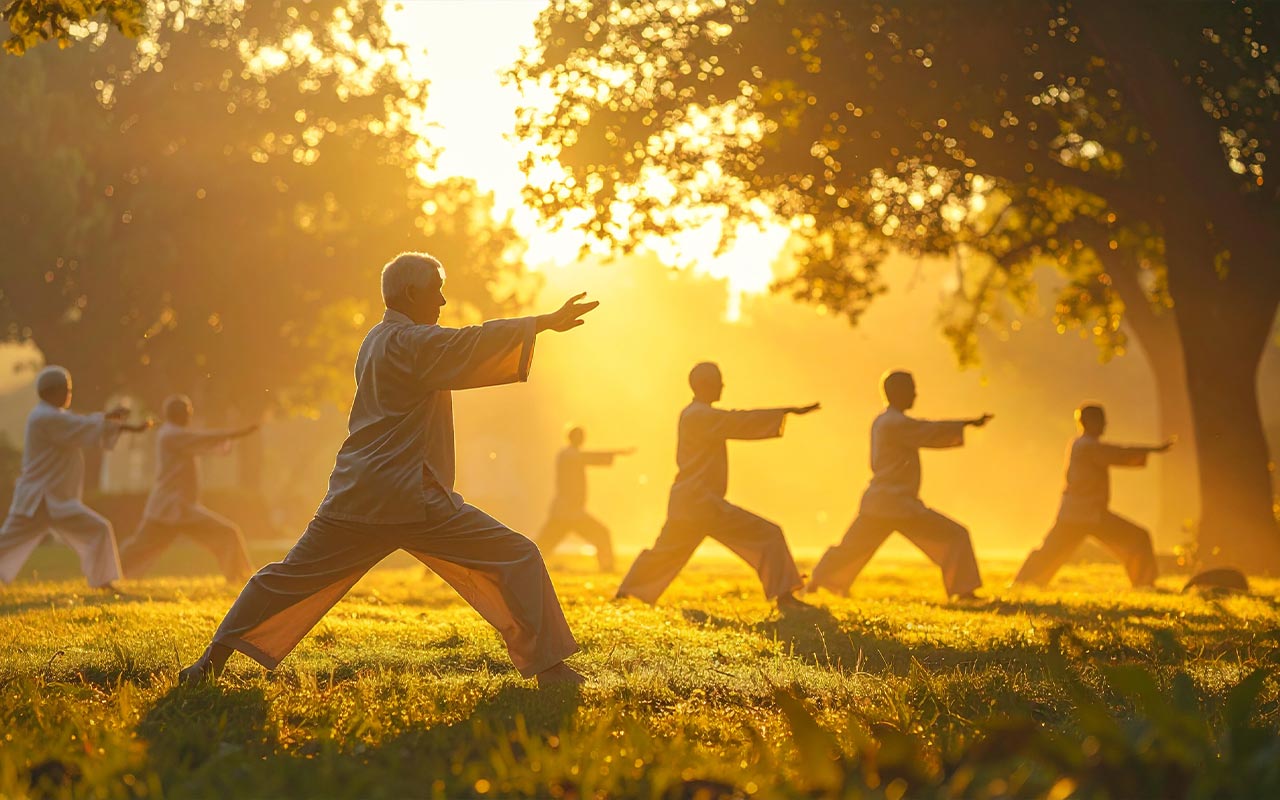
You may have seen groups of people in a park moving slowly and gracefully together — arms flowing, weight shifting, breath steady. It looks almost like slow-motion dance. Or maybe you tried Tai Chi yourself once, found it peaceful, and then life got in the way. Either way, you might be surprised to learn that what looks like gentle meditation is also one of the most complete fitness practices ever developed. This article explores what Tai Chi really is, where it comes from, and — most importantly — how you can get back into it today, even if it has been years.
What Is Tai Chi?
Tai Chi (also written as Taiji or T’ai Chi Ch’üan) is a Chinese practice that combines slow, flowing physical movements with breath awareness and mental focus. The full name — Taijiquan — roughly translates as “Supreme Ultimate Fist,” which immediately tells you something important: this is not just meditation. It is a martial art.
At its core, Tai Chi is built around the concept of chi (also written as qi) — the vital life force that, according to Traditional Chinese Medicine, flows through every living being along specific pathways called meridians. The goal of Tai Chi practice is to cultivate, balance, and direct that energy through the body. When chi flows freely, health and vitality follow. When it stagnates or becomes blocked, illness and imbalance arise.
What makes Tai Chi remarkable is that it works on multiple levels simultaneously:
- As a martial art — every movement has a self-defense application rooted in using an opponent’s force against them rather than meeting force with force
- As a moving meditation — the slow, mindful pace trains present-moment awareness and calms the nervous system
- As a fitness practice — it builds strength, balance, flexibility, and cardiovascular health in ways modern science is increasingly confirming
- As an energy practice — it cultivates chi through specific postures, transitions, and breath patterns that directly activate the meridian system
This is why Tai Chi has survived for centuries and is practiced by an estimated 250 million people worldwide today. It meets you wherever you are — whether you are a complete beginner, a returning practitioner, an athlete looking to improve recovery, or an older adult seeking to maintain balance and mobility.
Where Does Tai Chi Come From?
The origins of Tai Chi are genuinely ancient, and like much of Chinese history, they are layered with legend, philosophy, and gradual historical development.
The Legend of Zhang Sanfeng
The most well-known origin story attributes the creation of Tai Chi to a Taoist monk named Zhang Sanfeng, who is said to have lived sometime during the Song, Yuan, or Ming dynasties (roughly 10th–17th centuries CE). According to legend, Zhang Sanfeng witnessed a fight between a snake and a crane. The snake’s yielding, circular movements allowed it to evade and counter the crane’s powerful strikes. Inspired, Zhang Sanfeng developed a system of movement based on softness overcoming hardness — the central principle of Tai Chi.
Whether this story is historical fact or a teaching parable matters less than what it illustrates: Tai Chi is fundamentally about yielding rather than forcing, flowing rather than resisting.
The Chen Village and the Birth of a Family Art
Historically, the earliest documented lineage of Tai Chi traces back to Chen Wangting (1580–1660), a military officer from Chen Village (Chenjiagou) in Henan Province, China. Chen Wangting synthesized martial techniques, Taoist philosophy, Traditional Chinese Medicine principles, and Daoist breathing practices into what became Chen-style Tai Chi — the oldest surviving style. For generations, it was a closely guarded family secret, passed only within the Chen clan.
Yang Luchan and the Spread of Tai Chi
The pivotal figure in Tai Chi’s wider spread was Yang Luchan (1799–1872). Yang Luchan traveled to Chen Village as a young man, convinced the Chen family to teach him, and trained there for years until he had mastered the art. He then developed his own interpretation — what became Yang-style Tai Chi — and eventually became a martial arts instructor at the Imperial Court in Beijing. His descendants further refined Yang-style, simplifying some of its more physically demanding elements to make it more accessible. Today Yang-style is the most widely practiced form in the world.
The Major Styles
- Chen style — the oldest and most martial; alternates between slow movements and explosive bursts of speed; complex footwork and low stances
- Yang style — the most popular worldwide; large, expansive movements; gentle and accessible; ideal for health and beginners
- Wu style — compact movements, slight forward lean; excellent for developing internal energy
- Sun style — incorporates elements of Bagua and Xinyi; high stances; excellent for older practitioners and those with joint issues
In the 20th century, the Chinese government standardized a simplified form for health promotion — the 24-form Yang style (also called the Beijing or Simplified form) — which is what most beginners encounter today. It distills the essence of Yang-style Tai Chi into 24 movements that can be learned in a matter of weeks and practiced in about six minutes.
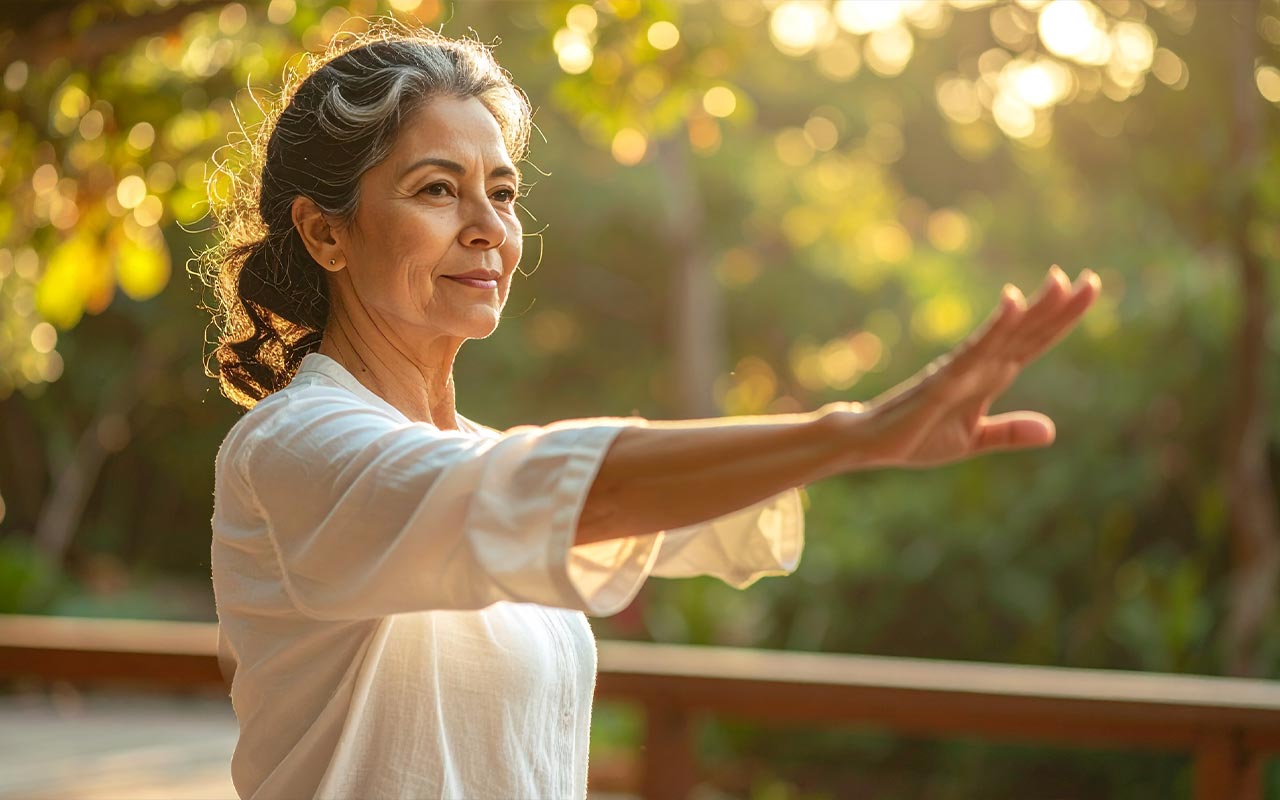
Tai Chi and Chi: The Energy Connection
The “Chi” in Tai Chi is the same chi (qi) at the heart of Traditional Chinese Medicine. According to TCM, chi flows through the body along meridians — specific pathways that connect organs, tissues, and functions. Tai Chi practice works with chi in several ways:
- Physical movement opens joints and relaxes muscles, removing physical obstructions to chi flow along the meridians
- Breath coordination — inhaling on withdrawing or rising movements, exhaling on advancing or sinking movements — activates the lung meridian and supports chi circulation
- Mental intention (Yi) — in Tai Chi, “where the mind goes, chi follows.” Focused attention on specific body parts during practice actively directs energy through the meridians
- Rooting — the emphasis on sinking weight downward connects practitioners to earth energy and stabilizes the lower dantian, the primary energy reservoir located about 3 cm below the navel
Is Tai Chi Actually Good Fitness? What the Research Says
Balance and Fall Prevention
This is arguably where the evidence is strongest. A 2019 review summarised by the U.S. National Center for Complementary and Integrative Health (NCCIH) found low-certainty evidence that tai chi may reduce the rate of falls in community-dwelling older adults by about 19%, and high-certainty evidence that it may reduce the number of people who fall by about 20%. Tai Chi constantly challenges balance through slow, controlled weight shifting while developing strength, proprioception, and reaction time. Source: NCCIH, Tai Chi: What You Need To Know.
Strength and Muscle Endurance
The slow, controlled movements of Tai Chi are deceptively demanding. Holding low stances, shifting weight with control, and maintaining correct posture throughout a 20–30 minute form engages the legs, core, and stabilizing muscles continuously. Research has shown meaningful improvements in lower body strength and muscle endurance in practitioners compared to non-practitioners.
Cardiovascular Health
Studies measuring heart rate during Tai Chi practice typically find it reaches 50–70% of maximum heart rate — placing it in the moderate-intensity aerobic exercise zone. NCCIH notes that a 2020 review of 28 studies found tai chi better at lowering systolic and diastolic blood pressure than health education or no treatment, other exercise, or antihypertensive drugs — but the authors judged the studies of poor quality and called for more research. Source: NCCIH, Tai Chi: What You Need To Know.
Joint Health and Flexibility
Studies in patients with osteoarthritis, rheumatoid arthritis, and knee pain consistently show significant reduction in pain and improvement in function with regular Tai Chi. This makes it particularly valuable for people who find conventional exercise painful — the full-range-of-motion movements gently nourish joints without loading them excessively.
Mental Health and Cognitive Function
Studies show significant reductions in anxiety and depression symptoms, improved sleep quality, and reduced cortisol levels with regular practice. Particularly interesting are findings suggesting Tai Chi may improve certain aspects of cognitive function and working memory — possibly due to the complex coordination and memorization the practice requires, combined with its stress-reduction effects.
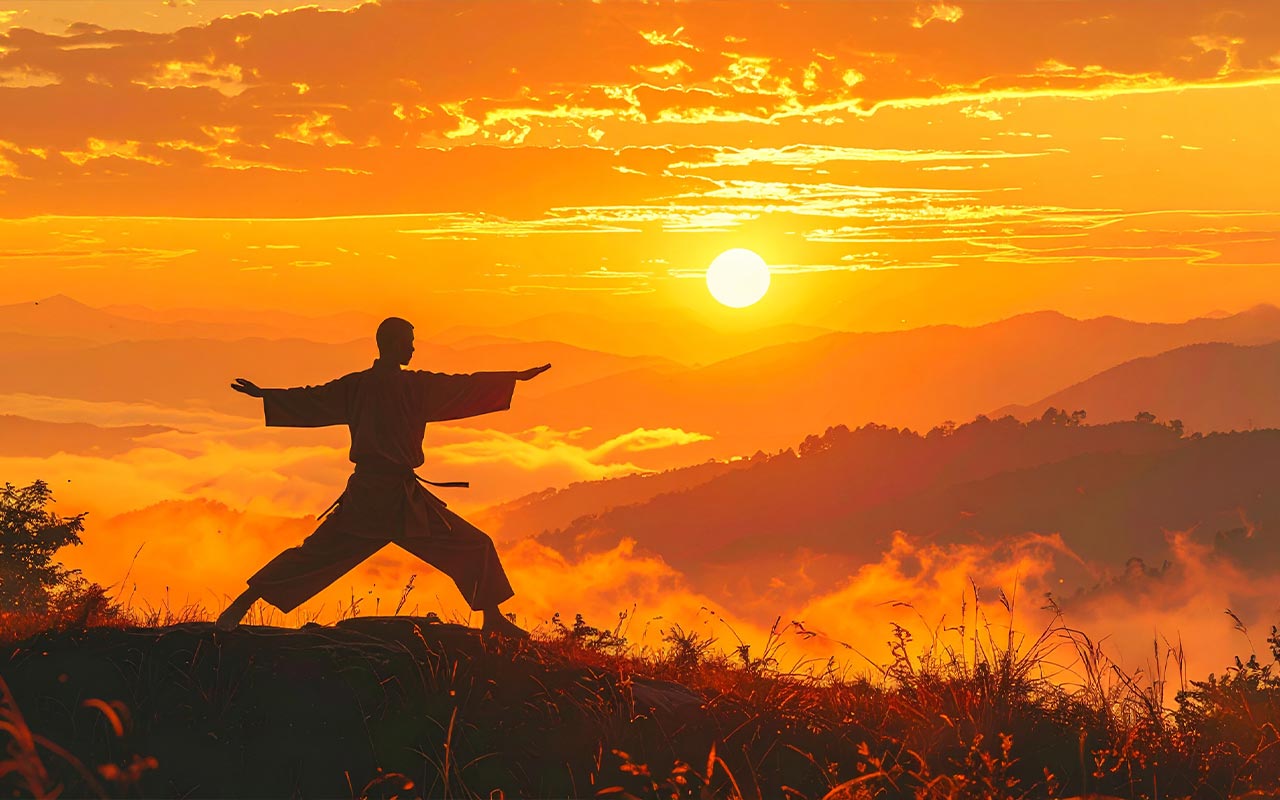
Getting Back Into Tai Chi: A Practical Guide
Step 1: Start With Standing (Zhan Zhuang) — 5 Minutes Daily
Before learning or relearning any form, the single most important practice you can do is standing meditation (Zhan Zhuang, pronounced “Jan Jwong”). This is the foundation of all Tai Chi and the fastest way to rebuild your internal sense of the practice.
- Stand with feet shoulder-width apart, toes pointing slightly outward
- Soften your knees — a very slight bend, not a squat
- Relax your hips and let your pelvis drop naturally (untuck, don’t tuck)
- Lengthen your spine upward as if a thread is pulling the crown of your head toward the sky
- Let your shoulders drop and soften; arms hang at your sides, or hold them as if embracing a large tree — elbows slightly bent, palms facing inward
- Soften your jaw, your eyes, your hands
- Breathe naturally through your nose; let your belly expand on the inhale, fall on the exhale
- Stand and notice: your weight, where tension lives, the quality of your breath — observe without forcing anything to change
Start with just 5 minutes. By week two, you will notice that 5 minutes of Zhan Zhuang leaves you feeling more grounded and clear than many activities that look far more strenuous.
Step 2: Core Movements to Practice Daily
Ward Off (Peng) — From a shoulder-width stance, shift your weight to your right foot. Raise your left arm in a curved “holding a ball” position — elbow bent, palm facing inward at chest height. Step your left foot forward into a bow stance. As you shift weight forward, your left arm rises to ward off, as if deflecting something coming toward you. The right hand drops to hip height, palm down. Repeat on both sides, slowly.
Cloud Hands (Yun Shou) — Stand with feet slightly wider than shoulder-width. Your hands move in large, overlapping horizontal circles in front of your body — one hand rising as the other falls, both moving in coordination with a slow side-step. Your gaze follows the upper hand. The weight shifts smoothly from foot to foot. This movement opens the chest, lubricates the shoulders, and develops coordination. Practice it as a moving meditation anywhere.
Repulse the Monkey — Step backward with your right foot, toes touching first, then heel. As you step back, your right hand draws back near your ear, then pushes forward while your left hand draws back. Walking backward in this coordinated, spiraling motion powerfully activates the spine and challenges proprioception. Practice 6–8 steps in each direction.
Step 3: A Simple Weekly Schedule
Weeks 1–2: 5 minutes Zhan Zhuang daily + 10 minutes basic movements 3× per week (≈ 35–40 minutes total per week)
Weeks 3–4: 5–10 minutes Zhan Zhuang daily + 15–20 minutes movement practice 4× per week + Cloud Hands as a daily walking meditation (≈ 60–80 minutes per week)
From Month 2: Consider finding a local class or structured online course for the 24-form. A teacher — even a video teacher — makes a significant difference in developing correct posture and alignment.
Tips for the Returning Practitioner
- Go slower than you think you need to. Most people move too fast. The benefit of Tai Chi is in the slow. When in doubt, halve your speed.
- Prioritize relaxation over perfection. Tension in the shoulders, jaw, or hands is the most common problem. Before each session, scan from head to feet and consciously release wherever you notice holding.
- Practice outside when you can. There is something qualitatively different about practicing Tai Chi outdoors — grass underfoot, air on skin, natural light. Many practitioners report deeper chi cultivation when connected to the natural environment.
- Treat every session as complete in itself. A 5-minute standing practice done with full attention is more valuable than a distracted 30-minute form. Quality of attention is everything in Tai Chi.
Final Thoughts
Tai Chi is one of those rare things that becomes more valuable the more you understand it — and more understood the more you practice it. What looks from the outside like elderly people moving slowly in a park is, from the inside, a sophisticated conversation between body, breath, mind, and the natural world.
It is meditation. It is fitness. It is martial art. It is chi cultivation. And it is one of the most accessible, adaptable, and thoroughly researched health practices available to anyone, at any age, at any fitness level.
If you practiced before and stopped — welcome back. Start with five minutes of standing today, and let the rest unfold from there.
Related reading: What Is Chi? The Vital Life Force · What Is Qigong? · The Heart Meridian · The Liver Meridian · The Kidney Meridian · Breathing Techniques for Chi Flow
Disclaimer: This article is for informational purposes only and does not replace professional medical advice. Always consult a qualified healthcare provider before beginning any new wellness practice.