In Traditional Chinese Medicine, the Stomach holds a position of singular importance: it is called the “Root of Postnatal Life.” While the Kidneys store the essence we inherit from our parents, the Stomach is responsible for extracting the energy and nutrition we need from food and drink throughout our lives. Everything the body needs to function — the Blood that nourishes the Heart, the fluids that moisten the Lungs, the Qi that moves through every meridian — ultimately depends on the Stomach’s ability to receive, ripen, and transform what we eat. When this foundation is strong, the whole system flourishes. When it is weak, everything suffers.
The Stomach in Traditional Chinese Medicine
In the five-element framework of TCM, the Stomach belongs to the Earth element — the element of centre, stability, nourishment, and the capacity to receive. The Earth element is associated with late summer, the season of harvest and abundance. Its color is yellow. Its emotion is worry. And its paired organs are the Stomach (Yang) and the Spleen (Yin) — two organs that in TCM are so closely linked that they are almost always discussed together.
The Stomach’s fundamental role in TCM is receiving and ripening — taking in food and drink, beginning the process of breaking it down, and passing what is usable downward to the Spleen for transformation. This downward movement is essential: healthy Stomach Qi descends. When it fails to descend — due to overeating, emotional disturbance, cold food, or stagnation — it rebels upward, producing nausea, belching, acid reflux, and vomiting.
The Stomach is the most “earthly” of the Yang organs: solid, practical, oriented toward the physical world of nourishment and sustenance. In TCM, it governs not only the digestion of food but also the “digestion” of experience — the capacity to take in what life offers, process it, and extract what is nourishing while letting the rest pass through.
The Pathway of the Stomach Meridian
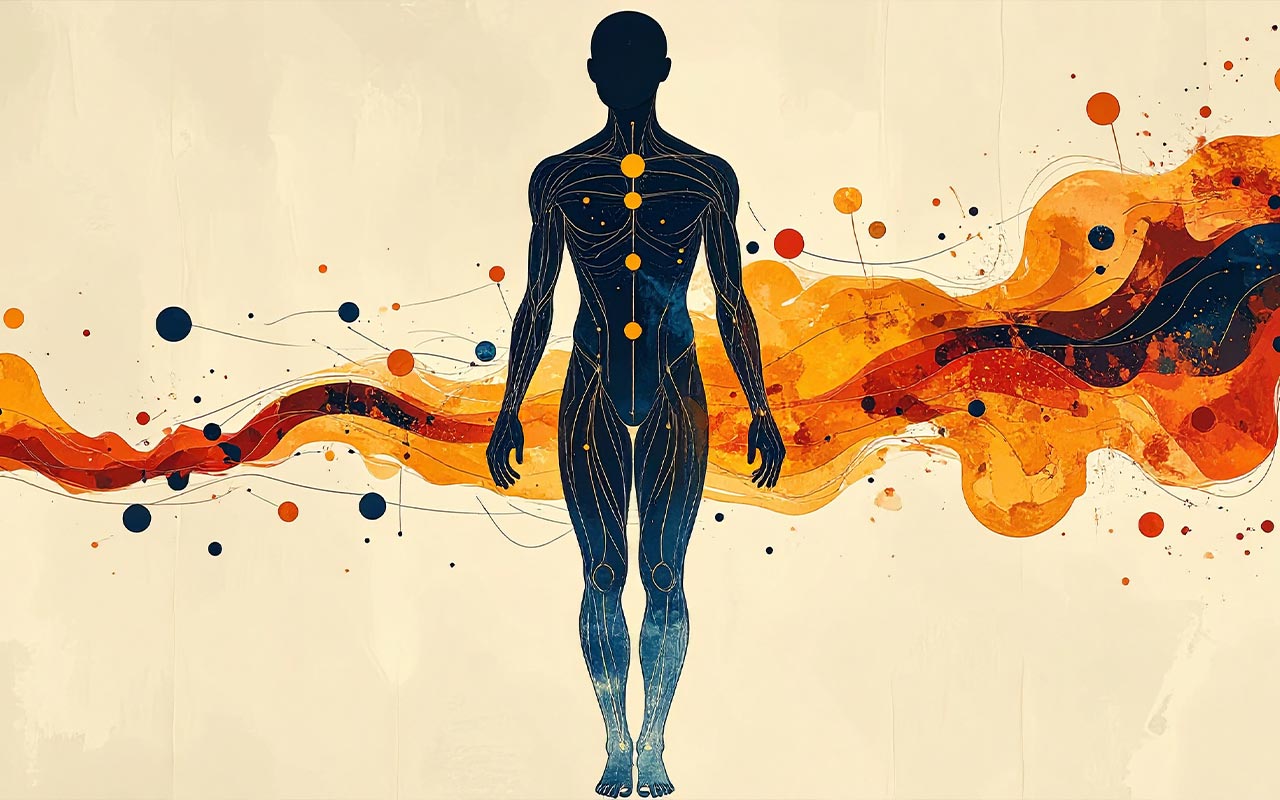
The Stomach Meridian (Zu Yang Ming — Foot Bright Yang) has 45 points running from the face to the feet. It is a long Yang channel, but not the longest: the Bladder Meridian has 67 points. This extensive pathway still explains why Stomach imbalance can show up in many areas of the body.
The pathway begins on the face and descends through the body:
- Begins below the eye at Stomach 1 (Chengqi)
- Descends along the cheek and jaw to the chin
- Ascends briefly to the temple and forehead
- Returns down the neck alongside the throat
- Crosses the collarbone and descends through the chest and abdomen
- Passes through the stomach and spleen organs internally
- Continues down the outer front of the leg
- Passes through the knee at Stomach 35 (Dubi)
- Continues down the shin alongside the tibia
- Crosses the top of the foot
- Ends at the outer corner of the second toenail at Stomach 45 (Lidui)
This lengthy pathway through the face explains why so many facial conditions — toothache, jaw pain, facial paralysis, eye problems, sinus congestion, headaches — are treated through the Stomach Meridian. The famous point Stomach 4 (Dicang) at the corner of the mouth is regularly used for facial palsy. Stomach 6 (Jiache) at the jaw is a primary point for toothache and TMJ dysfunction.
The Stomach Meridian is most active between 7am and 9am according to the TCM organ clock — which is why traditional Chinese medicine strongly recommends eating a substantial breakfast during this window. This is when the Stomach’s energy is at its peak, making it the optimal time to provide it with nourishment to transform.
What the Stomach Meridian Governs
- Receiving and ripening food and drink — the primary function; the Stomach is the first stage of digestion in TCM
- Downward movement of Qi — healthy Stomach Qi descends; when it rebels upward, nausea, belching, and reflux follow
- Production of “Grain Qi” — the raw material extracted from food that the Spleen then transforms into Blood and Qi for the whole body
- The face, mouth, and teeth — the meridian’s pathway through the face makes it responsible for the health of these structures
- The breasts — the Stomach Meridian passes through the chest and influences breast health and lactation in TCM
- The anterior leg and knee — the meridian’s pathway down the outer front of the leg makes it relevant to knee pain, shin problems, and leg weakness
- Worry and overthinking — the emotion of the Earth element; excessive mental activity, rumination, and worry directly impair Stomach function
- Mental clarity and groundedness — when the Stomach is well-nourished, the mind is clear, grounded, and able to think without obsessing
Worry, Overthinking, and the Emotional Dimension

The emotion associated with the Earth element — and therefore with both the Stomach and Spleen — is worry, understood broadly as overthinking, rumination, excessive mental activity, and the circular kind of thinking that returns again and again to the same concern without resolution.
In TCM, worry and overthinking are considered particularly injurious to the Stomach and Spleen. The physical effects are familiar: the stomach tightens under stress, digestion slows, appetite disappears or becomes erratic. The gut-brain connection, now well-documented in Western medicine, is precisely what TCM has long observed — the digestive system and the emotional-mental system are deeply intertwined, and disruption in one reliably affects the other.
The healthy expression of Earth element energy is the capacity to be present, receptive, and grounded — to take in experience without being overwhelmed by it, to think things through without becoming stuck in circular rumination, to nourish oneself and others without becoming depleted. When Stomach Qi is strong, there is a quality of quiet satisfaction, of being well-fed — not just physically, but emotionally and mentally.
In modern life, chronic worry is one of the most common contributors to digestive dysfunction. The relentless mental activity of contemporary professional and personal life — the emails that never end, the decisions that never resolve, the background hum of anxiety — creates exactly the conditions TCM describes as injurious to the Stomach.
Signs of Stomach Meridian Imbalance
Stomach Qi Deficiency
- Poor appetite or complete loss of appetite
- Bloating, distension, or discomfort after eating
- Fatigue — especially after meals
- Loose stools or diarrhea (often combined with Spleen Qi deficiency)
- A pale tongue with a thin white coating
- A general sense of physical weakness and poor muscle tone
Stomach Qi Rebelling Upward (excess/heat pattern)
- Nausea, especially in the morning or after eating
- Belching, hiccoughing, or acid reflux
- Vomiting — the most extreme form of rebellious Stomach Qi
- A sensation of heat or burning in the stomach or chest
- Bad breath
- Excessive hunger, particularly for cold foods and drinks
Stomach Yin Deficiency
- Dry mouth and throat — especially in the afternoon and evening
- Constant dull hunger without appetite for actual food
- A red tongue with little or no coating — a classic sign
- A burning sensation in the stomach
- Constipation with dry stools
- Low-grade anxiety and restlessness
Key Acupuncture Points on the Stomach Meridian
Stomach 36 — Zusanli (Leg Three Miles)
Located on the outer front of the lower leg, approximately four finger-widths below the lower border of the kneecap, one finger-width lateral to the tibia. This is one of the most important acupuncture points in all of TCM — a point so powerful for overall health and vitality that classical texts recommend moxibustion on it regularly throughout life as a longevity practice. Its name comes from the legend that soldiers could march “three more miles” after this point was stimulated.
Stomach 36 tonifies Qi and Blood, strengthens the Spleen and Stomach, boosts immune function, relieves fatigue, and supports digestion. It is one of the most thoroughly researched acupuncture points in clinical medicine, with evidence supporting its effects on immune function, gastrointestinal motility, pain relief, and anti-inflammatory activity. For self-acupressure, this is the single most valuable point on the Stomach Meridian to practice regularly.
Stomach 25 — Tianshu (Celestial Pivot)
Located on the abdomen, two finger-widths to the side of the navel on each side. This is the Front Collecting (Mu) point of the Large Intestine and one of the most important abdominal points for digestive health. It regulates intestinal function in both directions — useful for both constipation and diarrhea, depending on the technique applied. It also moves stagnation in the abdomen and relieves bloating, cramping, and distension.
Stomach 40 — Fenglong (Bountiful Bulge)
Located on the outer front of the lower leg, midway between the knee and ankle, approximately two finger-widths lateral to the tibia. This is the primary point for resolving Phlegm — a TCM concept that encompasses not only mucus and physical phlegm but also the heavier, more stagnant forms of internal dampness that accumulate from poor diet, overwork, and constitutional weakness. Stomach 40 is used for cough with phlegm, nausea, dizziness, mental fog, and obesity in TCM. It is also a significant point for anxiety and emotional disturbances related to Phlegm-Heat.
Stomach 44 — Neiting (Inner Court)
Located on the top of the foot, in the web between the second and third toes. This is the Water point on the Stomach Meridian — it clears heat from the Stomach channel and is particularly effective for toothache, facial pain, mouth ulcers, excessive hunger, bad breath, and any condition where Stomach heat is prominent. Pressing this point firmly during a toothache can bring rapid, noticeable relief.
Daily Practices to Support the Stomach Meridian
1. Press Stomach 36 Daily — The Longevity Point
Find the point four finger-widths below the lower edge of your kneecap, one finger-width outside the shinbone. You should feel a slight depression or sensitivity there. Using your thumb, apply firm, steady pressure and make small circular motions for 2–3 minutes on each leg. Breathe slowly and allow the sensation to spread.
This point can be pressed any time — morning, evening, after meals, during fatigue. Many practitioners recommend moxibustion on this point (applying gentle warmth from a moxa stick held close to the skin) during autumn and winter to build immune resilience and strengthen digestive Qi for the colder months. Daily acupressure on ST36 is one of the most evidence-supported self-care practices in all of TCM.
2. Eat Breakfast Between 7 and 9am
This is simple, culturally familiar, and grounded in TCM’s organ clock: the Stomach is at its energetic peak between 7am and 9am. Eating a warm, nourishing breakfast during this window gives the Stomach optimal conditions for transformation. Skipping breakfast or eating only cold foods (smoothies, yogurt, raw fruit) during this time is considered particularly draining to Stomach Qi in TCM.
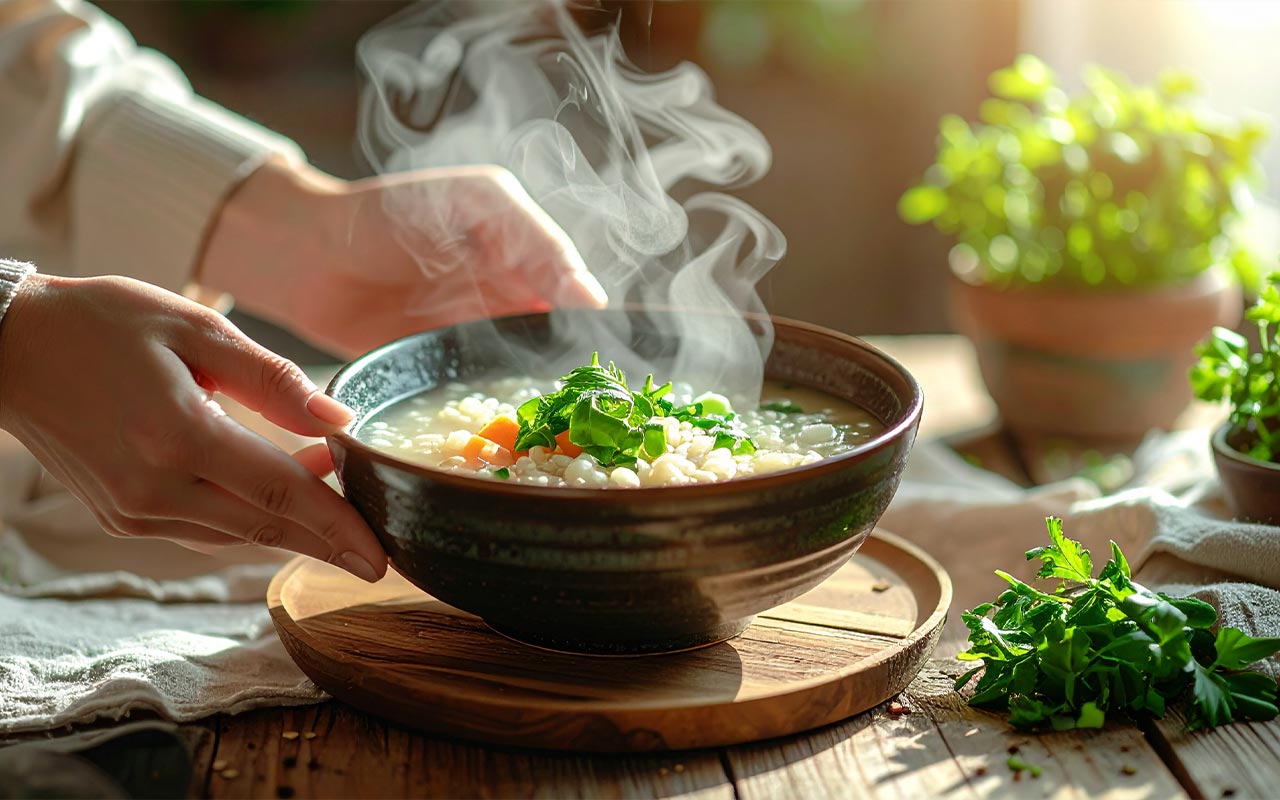
What constitutes a good breakfast for Stomach Qi? Warm, cooked, easily digestible foods: congee (rice porridge), oatmeal, eggs, warm soups, whole grains. The warmth matters — cold and raw foods at breakfast require extra Stomach energy to process and can deplete rather than nourish.
3. Eat Without Distraction
In TCM, the mental state during eating directly affects the Stomach’s capacity to receive and transform food. Eating while working, scrolling through a phone, or in a state of stress or worry is considered one of the most common causes of Stomach Qi disruption in modern practice. The nervous system is simply not oriented toward digestion when it is engaged with worry or screen stimulation.
The practice: eat at a table, without a phone or screen. Take three slow breaths before eating. Chew thoroughly. Notice the food. This is not a spiritual exercise — it is a physiological intervention that directly supports Stomach function and improves the efficiency of digestion.
4. The Worry Practice — Stopping the Loop
Because worry is the emotion most injurious to the Stomach, developing a relationship with this mental pattern is one of the most important things a person can do for digestive health in TCM. The key insight is that worry — unlike genuine problem-solving — is circular. It revisits the same concern without resolution.
A simple practice: when you notice worry-thought arising, ask “Is there something I can do about this right now?” If yes — do it. Write it down. Make the call. Send the email. If no — acknowledge the thought, and deliberately redirect attention to something present: the sensation of breath, the feeling of your feet on the floor, the taste of what you’re eating. This is not suppression; it is a choice about where to place attention. Over time, it rebuilds the Stomach’s capacity for groundedness.
5. Stomach-Supporting Foods
TCM associates the Stomach with the sweet flavor (in its natural, unrefined form) and the color yellow. Foods that support Stomach Qi include:
- Congee (rice porridge) — the classic TCM food for rebuilding Stomach Qi; gentle, warm, easily digestible, deeply nourishing
- Pumpkin and squash — yellow, sweet, warming; quintessential Earth element foods
- Yam and sweet potato — tonify Spleen and Stomach Qi; deeply nourishing
- Millet — the grain most associated with the Earth element in TCM; easy to digest and warming to the Stomach
- Ginger — warms the Stomach, relieves nausea, descends rebellious Qi; one of the most important herbs for Stomach health
- Cooked root vegetables — carrots, parsnips, turnips; warming, grounding, easy to digest
- Small amounts of natural sweetness — dates, figs, honey in moderation; enter the Stomach meridian and gently tonify
Reduce or avoid: cold and raw foods (especially in the morning), excessive dairy and greasy foods (create Phlegm-Dampness), coffee on an empty stomach (creates Stomach heat), eating too quickly, and eating too late at night.
6. The Abdominal Self-Massage
Lie on your back with knees slightly bent. Place both palms flat on your abdomen, just below the navel. With gentle but firm pressure, make large clockwise circles around the abdomen — following the direction of intestinal flow. Practice 30–50 slow rotations, breathing deeply throughout.
This practice stimulates the Stomach and intestinal meridians, gently encourages peristalsis, moves stagnant Qi in the abdomen, and activates Stomach 25 (Tianshu) on each side of the navel. It takes about three minutes and can be done first thing in the morning before getting up, or last thing at night before sleep. Many people notice improved digestion and bowel regularity within a week of consistent practice.
The Stomach Meridian and Late Summer
In TCM’s seasonal framework, the Stomach and Spleen are associated with late summer — that brief transitional period between the heat of summer and the cooling of autumn, often called the “fifth season.” This is traditionally the time to consolidate the energy of the active summer months and prepare the body for the inward, restorative quality of autumn.
During this season, emphasizing Earth element practices is particularly beneficial: warm, nourishing food, less raw and cold food, regular mealtimes, and conscious attention to worry and mental rumination. Strengthening the Stomach and Spleen in late summer is considered a key investment in immune resilience for the coming autumn and winter.
Final Thoughts: The Art of Nourishment
The Stomach Meridian offers one of TCM’s most practically useful insights: that nourishment is not simply a matter of what we eat, but of how we receive what life offers. The Stomach’s capacity to receive, ripen, and transform — to extract what is nourishing and pass on what is not — applies not just to food but to experience, emotion, and mental activity alike.
Eat breakfast warm and early. Press Stomach 36 each day. Put the phone away during meals. Notice when worry has become circular, and choose to redirect. Add ginger and congee to the rotation. These are not dramatic interventions — they are the quiet, daily choices that honour the Stomach’s role as the root of nourishment in everything it does.
Related reading: Understanding Meridians · The Heart Meridian · The Liver Meridian · The Kidney Meridian · The Small Intestine Meridian
Disclaimer: This article is for informational purposes only and does not replace professional medical advice. Always consult a qualified healthcare provider before beginning any new wellness practice.